It’s 1984 and Jim Oldaker’s newly-built Rollin’ Thunder monster van is almost ready to roll out. But can some divine intervention from ‘The King of Monster Trucks’ set him on the course to stardom, or will heartache and parts breaking keep him from living out his dreams?

A Ride With The King: Los Angeles, March 1984
In 1984, the former San Diego Clippers NBA team was controversially relocated without league permission to the city of Los Angeles by their equally controversial owner, the now-disgraced Donald Sterling. That year, while the legendarily successful Los Angeles Lakers NBA franchise called the groundbreaking LA Forum in Inglewood their home court, the Clippers would find themselves getting repeatedly thumped on their own hardwood inside the Los Angeles Memorial Sports Arena. Adjacent to the world-famous LA Memorial Coliseum, the LA Sports Arena had also briefly served as home ice for the LA Kings NHL hockey team during their inaugural 1967-68 season, before they too moved to The Forum. With all of this in mind, one could be forgiven for concluding that the LA Sports Arena was a bit of a second-class venue in the City of Angels; But in late March of 1984, a new kind of King came to play and get paid.

By the mid-1980’s, St. Louis general-contractor-turned-off-road-magnate Bob Chandler had become a sort of Godfather-like figure to four-wheel drive enthusiasts. Near simultaneously, his growing stable of “Bigfoot” monster trucks had established themselves, for the time at least, as “King of the Monster Trucks”. While the true origin story of the monster truck proper can be debated (as can Bigfoot’s claim to be “The Original Monster Truck”), the star-power and the immense crowds a Bigfoot appearance could draw in the mid-1980’s was not up for deliberation. The blue Ford F-250-based monsters were a seemingly perfect blend of craftsmanship, innovation and good taste.
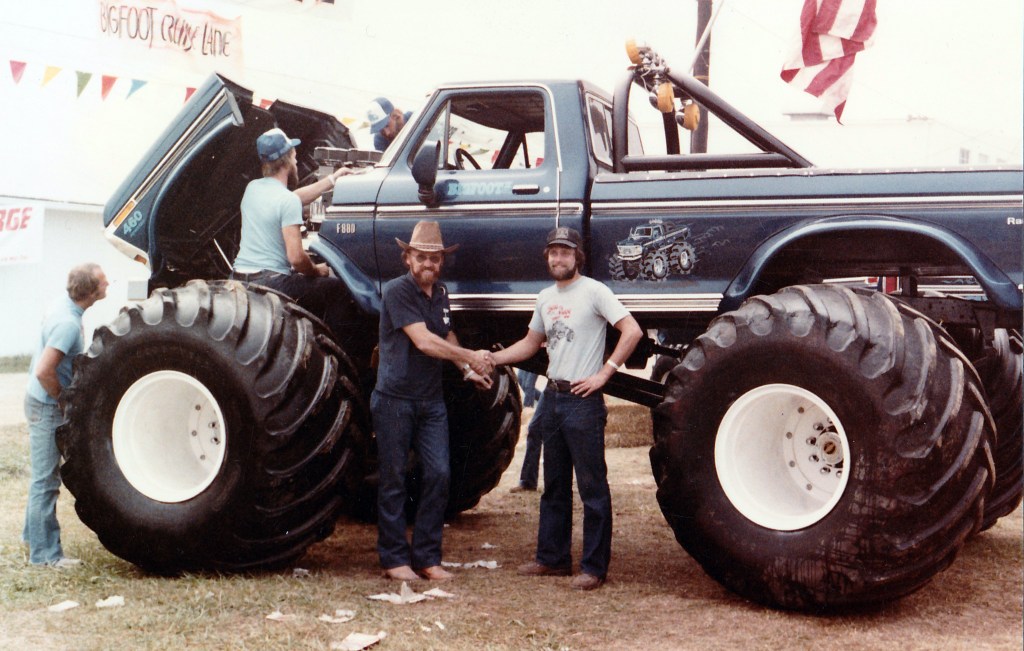
And 31-year-old Jim Oldaker was there to see it all for himself.
“At that point, I’d never even seen a monster truck in person,” Oldaker tells me, still bemused to this day that he nearly completed building his very own before even encountering someone else’s in real life. “I built Rollin’ Thunder using magazines for inspiration, like a loose guide to how I should build mine. Seeing Bob’s truck in person really opened my eyes to some things!”
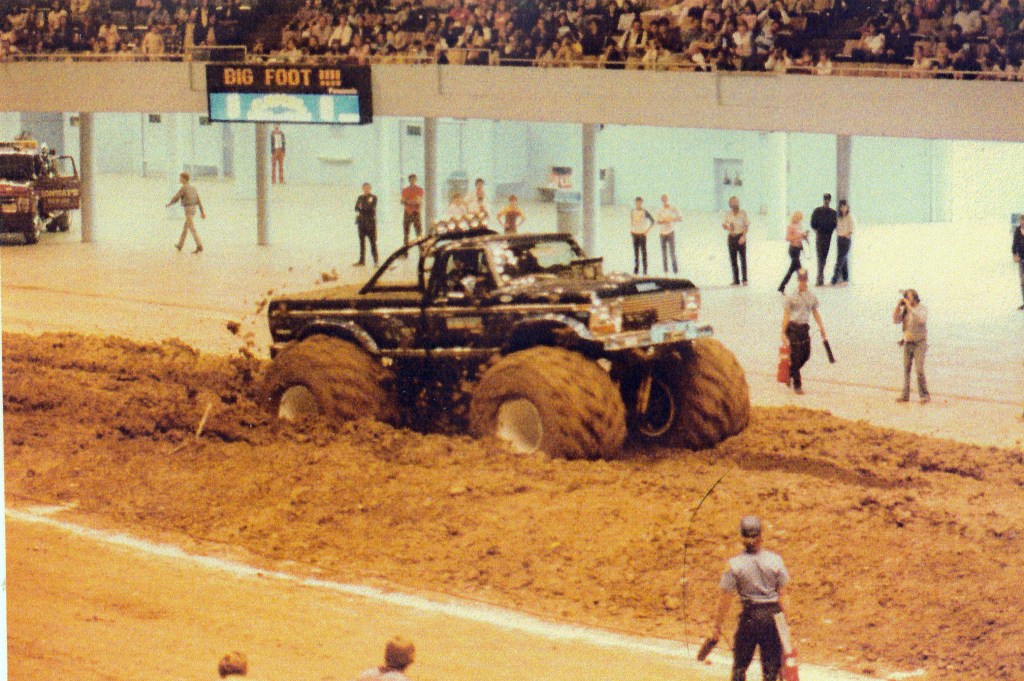
For one night only on March 31st of 1984, the then-Chicago-based SRO promotion company had brought their “United States Hot Rod Association” branded truck & tractor pulling and mud bog spectacular to the LA Sports Arena. And to help put asses in the seats they’d also booked Chandler and one of his Bigfoot trucks, “Bigfoot 2”, to perform their popular car-crushing routine along with some sled-pulling and mud-bogging duties. In between performances during Bigfoot’s mechanical triathlon that night, Oldaker was able to navigate his way through the throngs of attendees and get up close and personal with not just the Bigfoot truck, but Chandler himself.
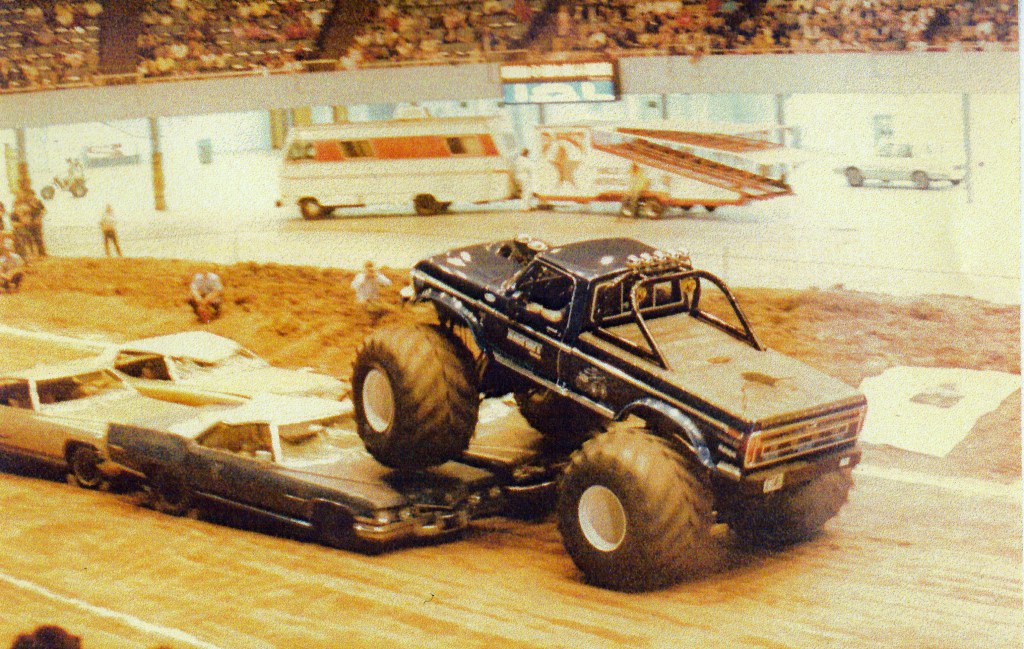
“Bob was incredible, he was so friendly and open and outgoing,” recalls Oldaker, the admiration for Chandler obvious in his voice. “I was standing there picking his brain for like, what must have been two hours in the middle of the show when the truck wasn’t doing anything. He’d pause from our conversation and talk to some other fans or sign an autograph, then he’d get right back to talking to me about my build and teaching me things about his truck. It was a wealth of knowledge he was giving me. Eventually, someone from the promoter came over and told him it was time for him to head out and crush cars. So I’m getting ready to thank him and walk away and he says to me ‘You want to ride with me?’ Of course, I said ‘YEAH!’, so he says ‘Well, get in!’ and away we went.”
Forgive my language here, but this deserves a “holy shit” from all of us. As a person who grew up fixated on monster trucks, made a career out of monster trucks for over a decade, as a person who has heard more wild and absurd monster truck stories than I’ll ever be able to publish (legally or otherwise), this story from Oldaker had me damn near speechless. I ask Jim “You mean to tell me that you had Rollin’ Thunder on its way to being complete, and your first time over cars in a monster truck ends up being in freakin’ BIGFOOT of all things instead of your own?!”
He laughs, I laugh, we all laugh. “What the hell are the chances of this?” I ask myself. “I was basically star-struck before I even got in the truck,” continues Oldaker. “I couldn’t believe I was getting to ride in a real monster truck, getting to ride in Bigfoot of all trucks, and now we’re crushing cars! I know I must have been overwhelmed by the feeling, the motion of the truck and everything, I was in awe just to be there. I actually don’t remember much of the ride over the cars or what exactly I was thinking, it was just overload.” He adds with another laugh “I must have looked to everyone in the crowd like the second-most important guy in the building at that moment, and I didn’t even realize it.”
Showbiz Ain’t Easy: Lancaster – Summer 1984
With the epic ride in Bigfoot now a fading memory in the rearview mirror, it was time for Oldaker and Rollin’ Thunder to finally put rubber to metal and show what they were made of. The first true test for the monster van and its unseasoned driver would be at a “Mud Mania” event in the city of Lancaster, about 90 miles north of Oldaker’s suburban LA base of Torrance. Oldaker elaborated a little bit from how he recalled his first-ever gig with Rollin’ Thunder came about:
“A mud bog promoter had heard about the truck, and they found the back alley behind my shop in Torrance where we had it parked at the time and saw the truck, then they convinced me to come do the show and paid me a deposit. I thought ‘Wow, we’re already getting paid and we haven’t even done a show yet!”
With the help of some friends, Oldaker trailered the new beast north to Lancaster for its official public debut, and the teething problems commenced almost immediately. “We tired the truck up on an asphalt parking lot, and at first on the transport tires, it was moving around just fine. I’d never really driven it on the big tires, so once we had them on the truck, we went to move it over to the outdoor dirt arena where we were supposed to perform later that night. When I tried to make a turn with the front and rear steering both, the whole thing just bound up, like, it just wouldn’t move.”
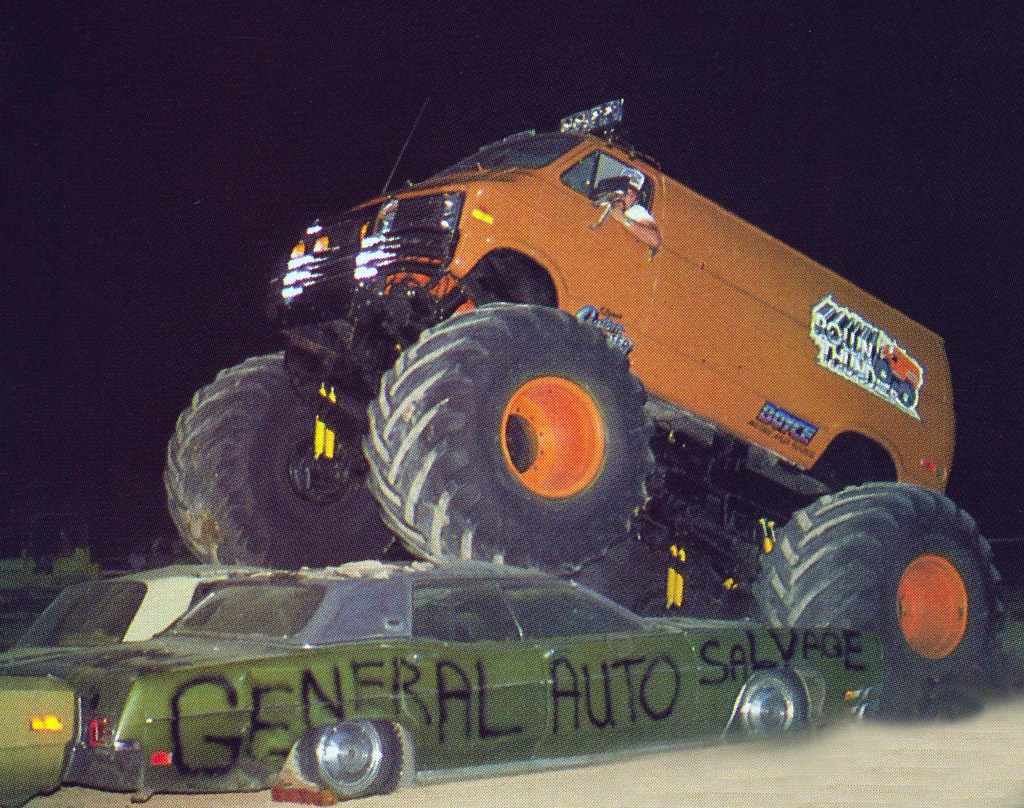
What Oldaker had just discovered by accident was that with dual lockers front and rear, a massive amount of grip from the monster truck-standard Goodyear 66” Terra-Tires and some hot asphalt, the truck was not going to be happy trying to make tight turns, especially if the transfer case was still engaged in 4WD. Oldaker explained that “It was so early in the game, I didn’t have locking hubs installed on the front yet either, so it really was bound up on me. I was too scared to give it any real power to try and get it to break free, so I shut the truck off and got out to see what was going on. We all figured that the big tires had so much grip on the pavement that they were binding up the lockers, so we jacked each end of the truck up to release the lockers and drove straight for the dirt area. Once we got to the dirt, we were a lot better off.”
Notable off-road journalist Jeff Johnston had traveled out to Lancaster for this occasion, documenting Oldaker and Rollin’ Thunder’s maiden voyage into showbiz for what would eventually become a multi-page feature in Four Wheeler Magazine’s “Monster Trucks II” special that was set to drop later in 1984.
“After the crowds were thrilled by the mud bog contestants at the Mud Mania-sponsored
event in Lancaster, California, a set of sacrificial cars were dragged onto the track. Oldaker,
his face showing concern over possibly blowing his first public car crushing exhibition, took
the van for a couple laps around the track at the fairgrounds while the crowd roared its
approval with enthusiasm. Then, the moment of truth: a touch of the throttle after a careful lineup with the cars and the diesel barked and rumbled while the van made it up, over and down the other side of the now-remodeled sedans. Oldaker climbed from the cab with an ear-to-ear grin and took a bow as applause filled the balmy night air. Another new monster truck has been born.”
While I trust the framework of Johnston’s description of the night’s events, I’ve been around monster trucks far too long to simply assume everything was the only-slightly-nervous-cakewalk that he paints it as with his Positivity-brand brush.

My suspicions were confirmed when Oldaker gave me his side of things.
“Driving Rollin’ Thunder wasn’t exactly easy, because of the 2-stroke Detroit and the manual transmission. Honestly, if I would have had the money and the right kind of shop and tools I would have put an Allison automatic transmission in the truck, but I ended up having to use the stock 5-speed gearbox that came bolted up to the Detroit Diesel. 2-stroke Detroits had a really narrow powerband, and the transmission had a granny-low first gear that you really couldn’t use, so I did almost everything in second gear. If I tried to shift to third, the long shifter throw caused that to take quite a long time and the truck would slow down so much during the shift that you’d just bog down once you hit 3rd gear. The truck would just fall right out of its powerband and you’d damn near come to a stop.”

Further complicating things was the potential that 2-stroke diesels like Oldaker’s Detroit had to actually run backwards on their own crankcase oil. Oldaker explained to me that when climbing up a set of cars, if you didn’t aggressively drive the truck up onto the cars and it started to stall and roll backwards at all while in gear, it could actually spin the motor backwards and it would suck oil up from the bottom end of the engine and actually combust (albeit poorly, with lots of smoke for effect) with the end result being a backwards-firing engine.
“It was traumatizing!” said Oldaker, indulging in approximately 0% hyperbole. “I had no idea what I was doing out there, I was just hoping the thing held together and didn’t break and embarrass me. I needed to get paid too of course, so there was a lot on my mind I guess,” he told me, the relief still evident in his voice all these years later.
“I was glad when it was over.”
Sailboats, Shifting & Stormy Seas: Redondo Beach and Beyond – 1984 to 1987
While you could hardly call any monster trucker’s life “simple” or “ordinary”, especially in the mid-1980’s, Oldaker’s life was anything but either of those things, even among his contemporaries in the business. Beyond the generally understood complications of owning and operating a monster truck (more on that in a bit, naturally), there was the fact that Oldaker never really had a proper permanent shop to base Rollin’ Thunder out of. There was also the fact that Oldaker was married to his then-wife Joyce and they were living in the marina at Redondo Beach, California with their children….aboard a sailboat. And not terribly long after Rollin’ Thunder’s debut in Lancaster, the truck’s touring schedule became noticeably more intense. This increased the stress not only on Jim, but also on Joyce who eventually found herself and their two children sitting 3-wide in a single-cab S-10 pickup following behind Oldaker as he hauled Rollin’ Thunder up and down the road in a transporter rig that at times was barely up to the task.
“Tell me about the whole sailboat thing, how in the hell did that come about?” I ask Oldaker, pointing out the obvious assumption many of us have had of him in the past: “Oh, what an eccentric and stereotypical Californian that guy must have been, living on a sailboat and racing monster trucks and all that!” But I implore him to flesh this part of his story out, because it can’t just be that simple. And it isn’t.
“Ok, so, the sailboat thing. When we first moved back to California from Kansas, we stayed at my in-laws’ house, and we met these friends they had who were an older couple, and they had a sailboat. They ended up inviting us to go out on their boat sailing with them, and we agreed to join them. They took us out and we sailed to Avalon on Catalina Island, and I went ‘God, this is AWESOME!’ After that, I bought this cheap old sailboat for like $6,000 or something, and it turned out to be a piece of junk. It didn’t sail well, it had kind of a weird design and wasn’t very reliable.” And in the world of sailing boats, unreliability is a hell of a safety liability.
“One time, we had sailed out to Catalina Island on our boat, and when we were leaving the isthmus of Catalina Island and the engine quit as we were putting out. So we tried to sail all the way back to the mainland, and just as we had gotten most of the way back, somewhere pretty near Palos Verdes, the classic California coastal fog rolled in and the wind just died. Flat died. And so did our sails. It seemed like all we could hear were the waves crashing ashore on the rocks, but the way the sound was carrying we really had no idea exactly how close we were to shore. Not only were we terrified of getting smashed up onto the rocks by the waves and current, but we also had to worry about getting run down by a bigger boat if there was one out there in the fog we couldn’t see. It wasn’t the best time.”
Oldaker eventually discovered a company that let buyers purchase an empty sailboat hull and deck that the owner could then spec out as they saw fit for their own needs, a sort of nautical blank canvas for a “reasonable” price. “I installed a motor in the hull myself, and built out the interior the way I wanted it,” explains Oldaker. “The way I saw it, a boat was basically just a van on the water, so why not build my boat out the way I wanted it?” Years later, Oldaker’s marine know-how would see him finding no small amount of work in the Redondo Beach marina. “I loved sailing, it was absolutely amazing. And that boat I built would damn near sail itself all the way out to Catalina and back. I ended up living on it for nearly 16 years!”
All was not perfect with the second Oldaker sailboat situation, however. One time, while Jim was touring with Rollin’ Thunder and his then-wife Joyce was on the boat by herself with the kids, the flame inside the boat’s kerosene stove somehow got out of control. The fire eventually burned through the kerosene fuel hose sprayed flaming kerosene all over the sailboat’s interior. Thankfully Joyce was able to save herself and the children, escaping relatively unscathed by the accelerant-enhanced blaze. The fire very nearly consumed the boat before fire crews and volunteers could extinguish the blaze, which somehow spared the hull and bulkheads. After a significant and protracted insurance claim, Oldaker was able to rebuild the boat back to a pristine, livable condition. However, as time went on things would change between Jim and Joyce and while they remained plenty amicable, she would eventually move back to live with her parents in the LA suburb of Englewood, while Oldaker would remain the sole occupant of the revamped sailboat.
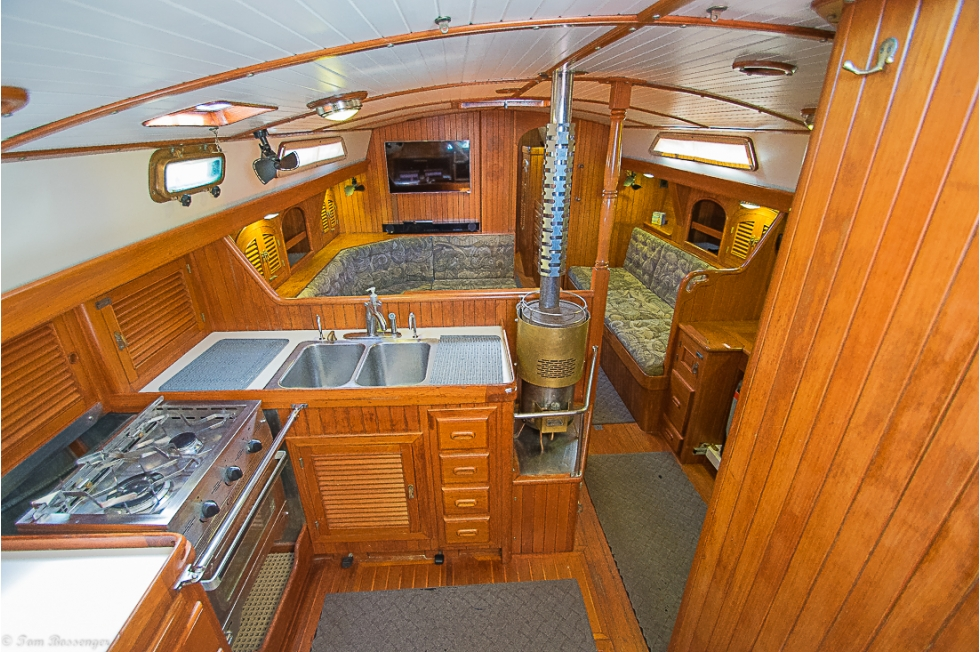
When asked how Oldaker was able to secure pretty high-profile bookings so early in his career with Rollin’ Thunder, gigs that we’ll touch on later in this piece, he was quick to point out the variety of different kinds of effort Joyce made to help get Rollin’ Thunder on the road, and to help keep it there while doing her best to also help raise their kids and keep the family together. Joyce had a flair for grassroots marketing, and with the help of her parents (who conveniently owned a print shop) they were able to put together Rollin’ Thunder information packets that they sent out to promoters, media outlets and potential sponsors around the country. From his first big break with Darryl Starbird’s car show circuit to SRO’s United States Hot Rod Association to sponsors like Boyce Equipment and Detroit Diesel, Joyce’s efforts behind the scenes shouldn’t go unnoticed in the telling of the Rollin’ Thunder saga.
Her willingness to chase Jim and the monster truck hauler up and down the highways and byways of the United States whenever she could, often with her and the children stuffed into the cab of a compact pickup truck shouldn’t be ignored either. And that’s why we now have to talk about Oldaker’s transport rig, a sort of strange and not-really-wonderful mutant of a rig, the sort that hardcore monster truck fans are not only familiar with, but actually like to fawn over. I’d be lying if I didn’t admit to engaging in some mechanical schadenfreude while admiring photos and video and even in-person interaction with the sketchy, the cob-job, the homemade and the “creative” sorts of haulers that have pervaded the industry for decades.
“My semi was just an old Dodge yard tractor [Editor’s Note: A “yard tractor” in this context refers to a short, single-cab semi-tractor that is used in big semi-truck yards where quickly and efficiently moving semi-trailers around between docks and parking spots is critical, places like distribution centers or large manufacturing facilities.] It had just enough wheelbase that I was able to sort of graft an overhead camper onto the back with the help of a guy I knew, and it was basically just a shell, a piece of junk. It rattled itself apart going down the road, you could literally see sawdust falling out of it if you followed it like Joyce had to. It wasn’t something you could really ride in going down the road and it was definitely not something to sleep in, especially when the weather was cold or bad. Much later on, we bought a nicer bus-style RV camper to follow the monster down the road, but that was a lot later on, kind of closer to the end of things.”
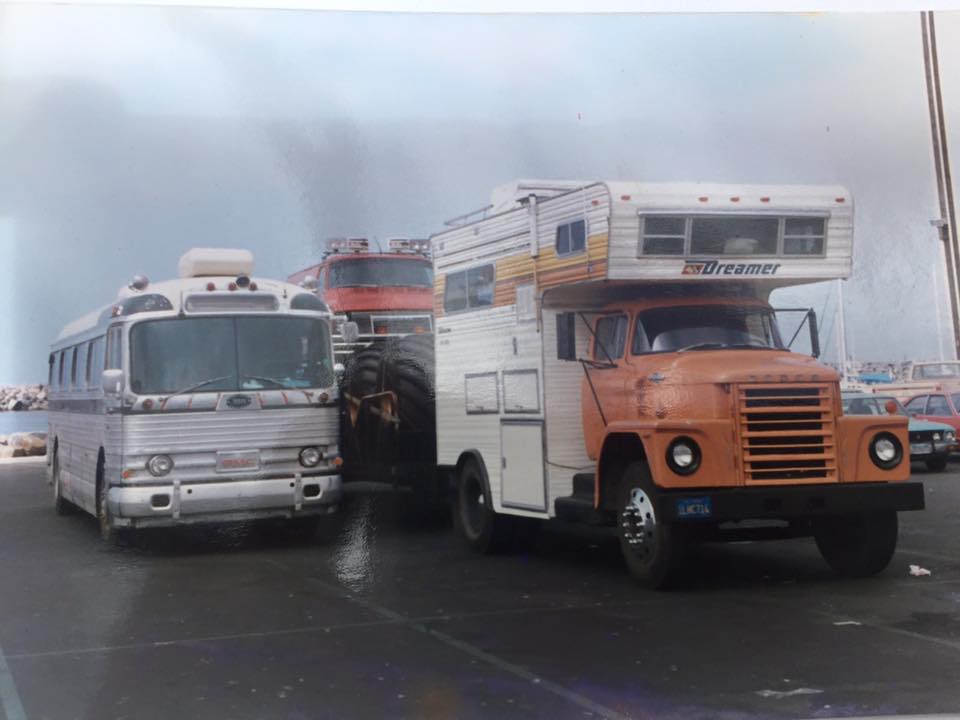
To be certain, the first year or so of touring for the Oldakers was particularly stressful on them. Living life on the road as a touring performer of any sort can be stressful even under ideal conditions, but given the budget-conscious nature of Oldaker’s fledgling operation and the steep learning curve he was experiencing as a newbie to the monster truck game, all coupled with the additional complications of having his family traveling along with him in a separate vehicle, it becomes easy to see how a person could find themselves hanging on by just a few threads mentally and physically. Pile on some unexpected mechanical woes, many sleepless nights and the prospect of failure in just the first few months of operating the monster truck and you begin to see just how bare those threads likely were for Oldaker and by extension his family.
Drive Til You Break: Kansas City – November, 1984
When legendary car customizer and car show promoter Darryl Starbird got wind of Oldaker’s “Rollin’ Thunder” by way of a press packet that Joyce had helped put together and mailed out, he jumped at the opportunity to book Oldaker’s new and relatively unproven machine to perform at a season’s worth of Starbird Car Shows. He liked Oldaker, having gotten to know him well enough during Oldaker’s appearances at some of his shows with the “Warlord 1” custom van, and he knew that being among the very first promoters to feature what was apparently the world’s first true “monster van” would help attract larger crowds to his events. Starbird’s car shows were beginning to feature an increasing number of monster truck performances as part of their draw, including a pair of trucks built by his son Cliff, “Monster Vette” and “Frankenstein”.

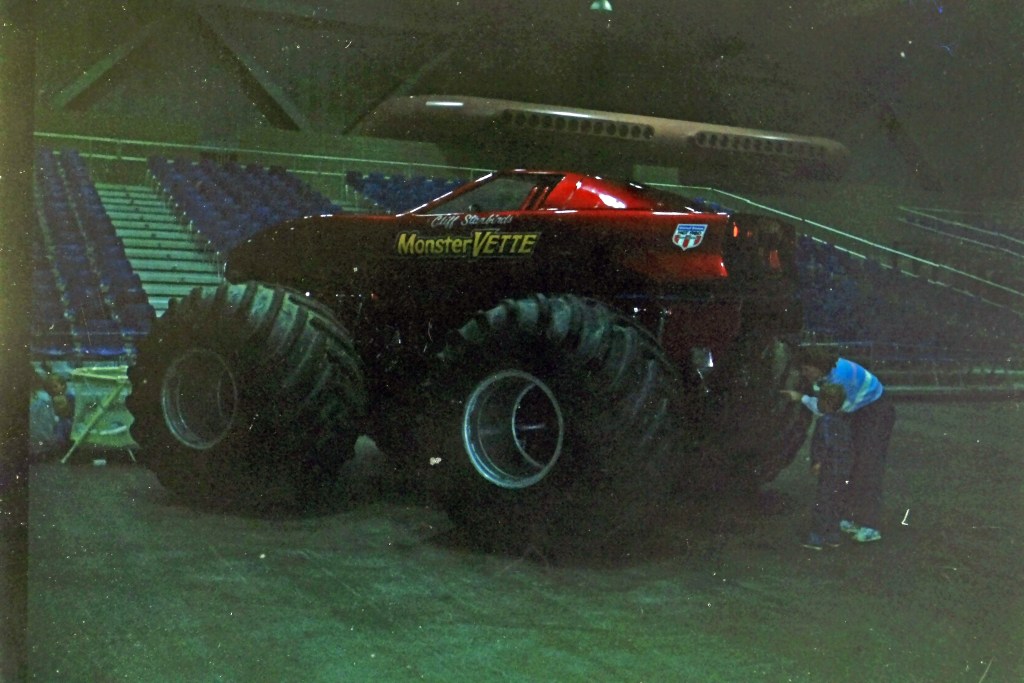
“Darryl put me under contract almost as soon as he saw our packet,” says Oldaker. “He booked me to run his whole season of car shows, maybe six or eight cities or something, I can’t recall exactly. But anyways, my first appearance for him was going to be at one of his shows in Kansas City, at the convention center, over the long Thanksgiving weekend in 1984. I still hadn’t crushed a ton of cars yet with the truck and was still having troubles with the lockers and stuff binding up, so I took whatever gigs I could to get some more practice.”
One of those gigs was a time in the summer of 1984 that Oldaker recalled, when he ended up crushing cars along with some familiar names you might remember from some of my other OSMT pieces. “As soon as things started getting serious with Rollin’ Thunder, my business partner in Streetable Customs bought me out and I couldn’t keep the truck at that shop anymore, plus it was too small anyways really. So, a friend who owned Stone Tire in Wilmington [Editor’s Note: Another LA Suburb, about 10 miles from Redondo Beach and adjacent to the Port of Long Beach] let us keep the truck there when we weren’t on the road with it. Anyways, by this time Seth Doulton and Jim Ries had built the Skoal Bandit and the owner of Stone Tire had arranged for them to crush cars along with me and Rollin’ Thunder in the road out back of the tire shop.”
And what could possibly go wrong with that? An unauthorized car-crushing demonstration in a public street with two monster trucks and zero permission from the local governing body or constabulary, with the accompanying mass of passers-by and even a local 4WD club to serve as witnesses. As it turns out, the aforementioned local constabulary was in the area and quickly caught wind of the guerrilla exhibition just before it kicked off.
“As soon as I saw the cops, I looked at Jimmy [Ries, Skoal Bandit driver] and said ‘Oh shit!’ I figured they were going to shut the whole thing down, maybe write us tickets or something.” But to Oldaker’s surprise and relief “they hung around and did traffic control for us and let us do the car crush right in the street!” Afterwards, the 4WD club attempted to take several of their rigs across the now decimated junk cars only to find out the hard way that you needed something a little heavier duty than what they had even to tackle already crushed cars. Some jobs are better left to the monsters, it would seem.
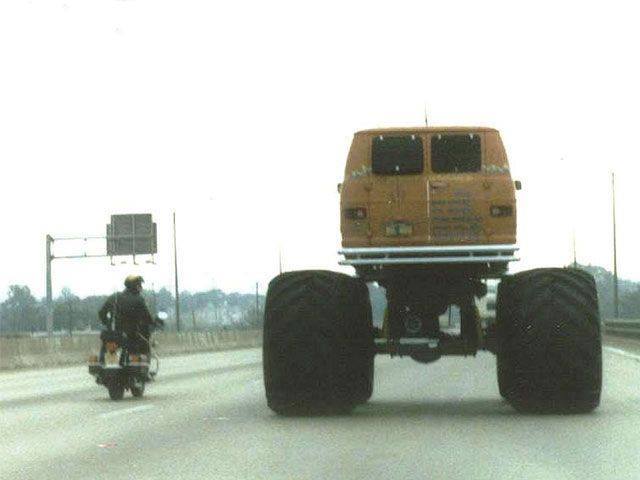
Months later and with a few more car crushes under his belt, Oldaker was gearing up to head east for the start of his run of Starbird Car Shows, beginning with the aforementioned Thanksgiving weekend event in Kansas City. But before he could load up to head east, he had one more SoCal gig to knock out in Long Beach, a conveniently short drive from his base of operations in Wilmington and his marina home in Redondo Beach. After that would come the real test of Oldaker and his transporter rig, with more than 1,600 long miles that needed driven to get from warm and sunny LA to the near-frozen climate of KC. While Oldaker had managed to put Rollin’ Thunder through some successful performances by this time, he’d also suffered his fair share of mechanical failure and frustration, namely with the tendency the truck’s lockers had of making it a bear to drive when on paved surfaces. That, and a startling new problem that began to plague him with increasing frequency as of late: broken outer axle shafts.

Oldaker explained to me how things started to unravel some for him at the Long Beach gig: “We got hired to do a car show at the Long Beach Convention Center, the weekend before Thanksgiving of ’84. I’d broken an axle here or there leading up to that and had gotten pretty good at fixing them, or so I thought. Turns out I knew even less than I thought I did! I was as careful as I could be to drive the truck just right, trying not to break anymore axles even though I had plenty of spares. By the end of the gig in Long Beach, I swear we broke an axle just driving over a water bottle. I had to be out in Kansas City in just a couple of days by the time the car show ended, so I hustled to get all of the axles fixed, loaded the truck up on the trailer and took off heading east, hoping like hell that my hauler was going to make the drive without breaking down.”
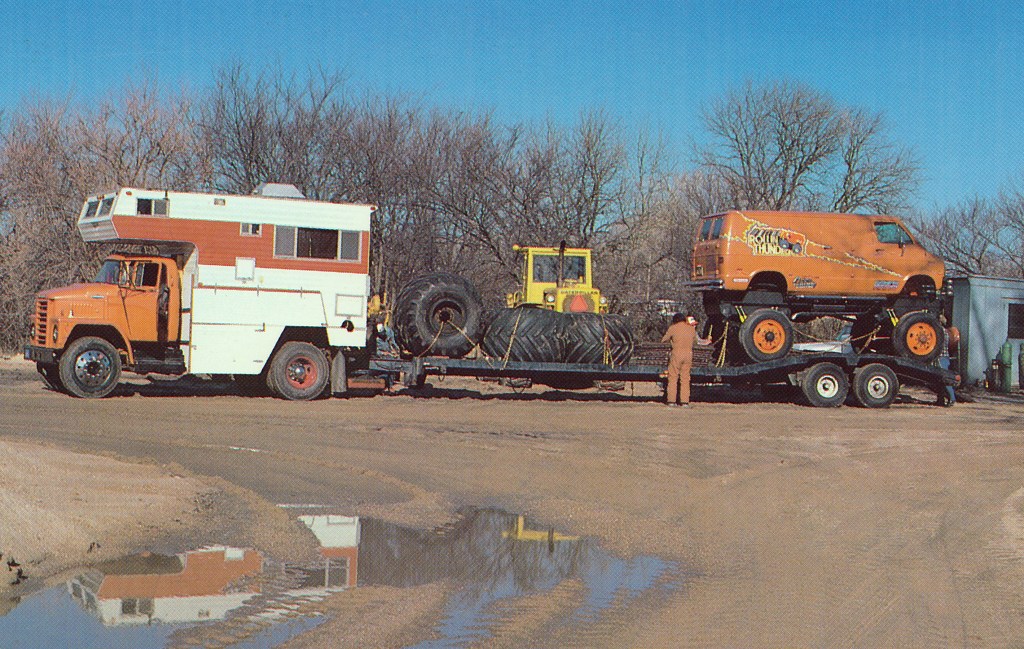
Normally when you tell someone you’re “tired from a long weekend in Long Beach”, it doesn’t mean that you’re mentally and physically drained from the stress of multiple car-crushing performances and the repeated changing of decades-old military truck axles under your still-new monster truck. That would be the case for Oldaker though, as he and he alone made the long climb out of the San Bernardino Valley on Interstate 15, heading north towards Barstow before heading east on Interstate 40 for a nearly 1,000-mile-long slog across the American southwest. After disposing of those mostly-dreary highway miles on the Interstate system’s replacement for historic Route 66, Oldaker presumably would have broken off in Tucumcari, New Mexico to cover another 430 miles of Route 54 on a northeast trajectory towards Wichita, Kansas. So many billboards along Interstate 40 famously compel drivers to stop in “Tucumcari Tonight!”, but for Oldaker there would be virtually no stopping along this journey apart for the requisite fuel, food, caffeine and restroom breaks that he and his Dodge tractor required.
After reaching Wichita, Oldaker steeled himself for the last few remaining hours of drive time as he navigated his way onto Interstate 35, Kansas City almost in his tired, blurry-eyed sight. It was now the day before Thanksgiving, and Oldaker started to allow himself the indulgent thoughts of how nice his hotel bed was going to feel once he reached downtown KC and dropped the rig off at the convention center. How nice a warm meal and a deep, long sleep would feel. Oldaker was of course assuming that the Starbird Car Show wouldn’t open on Thanksgiving Day, that would be ridiculous. He planned on resting up all day on Thanksgiving before getting Rollin’ Thunder ready to do its thing for three consecutive days at Bartle Hall, beginning with his first crush on Friday afternoon. Oldaker was quickly stripped of these restful ideas once he arrived in Kansas City on Wednesday evening, the night before Thanksgiving.
“I was exhausted when I got there, but thankfully I didn’t hurt myself or anyone else along the way. I shouldn’t have been on the road like that, but the situation was kind of stupid, I was being kind of stupid and I just had to get there. I got there Wednesday night and parked it, thinking I had a whole day on Thursday to sleep. But then Darryl tells me he’s opening the car show on Thanksgiving to make it a 4-day show.” There might have been some cuss words invoked in the wake of this information being made known to Oldaker.
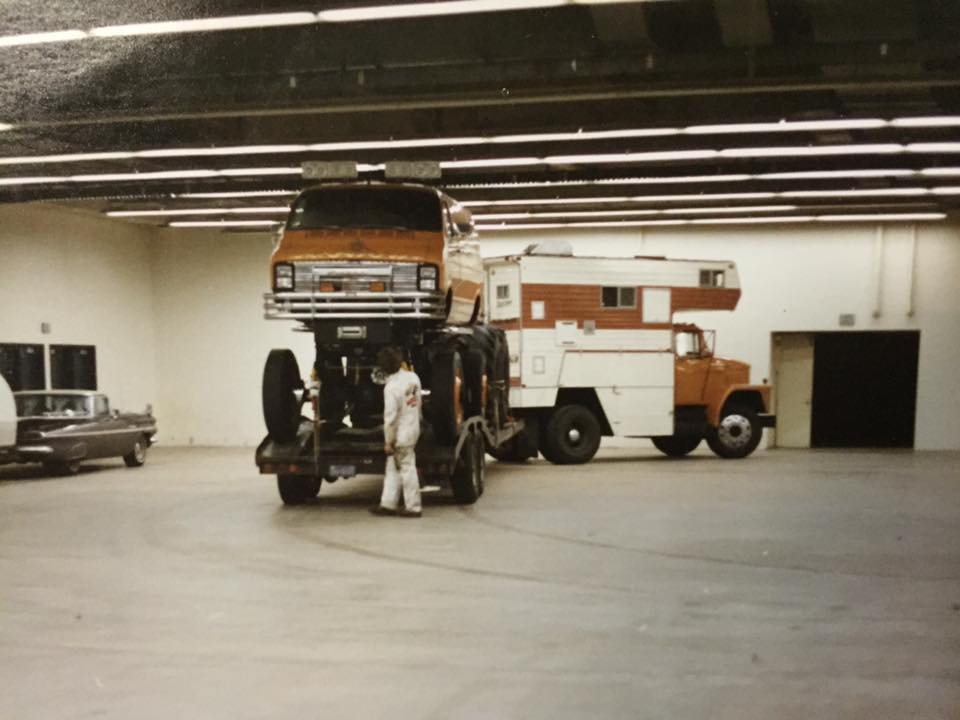
“I went and slept for a few hours then had to get back to the convention center early to get the truck unloaded and set up. I was still nervous about breaking more axles, and I ended up not driving very well given how tired I was,” Oldaker tells me. At the time, Darryl Starbird Car Shows featured monster trucks participating in what has to be considered “racing”; that is to say, two trucks lining up to crush separate sets of cars with the first to complete the task by getting all four wheels back onto solid ground being deemed the winner. While the 1986 USHRA event at the Louisiana Superdome that was filmed for the “Return Of The Monster Trucks” special (which also featured Oldaker and Rollin’ Thunder) often gets mistaken as being the “first side-by-side monster truck race”, the reality is that Starbird Car Shows (and perhaps other lesser-known events) did in fact feature “side-by-side monster truck racing” well before that particular Superdome event. But back to Oldaker’s challenges in Kansas City:
“I was racing against Darryl’s son, Cliff, and he was in Frankenstein, I’m not sure if he’d finished the Vette just yet. I was just so damn tired, I wasn’t driving well, and as I mentioned before, my truck wasn’t the easiest to drive. A car or a couple of cars moved weird underneath me when I was racing Cliff and I started to get stuck. I tried giving it some power to pull out of the mess so I didn’t get stuck but I ended up breaking all four outer axles. Somehow, we got it off the cars and I spent the night fixing it all so we could carry on with the weekend.” By the end of the long weekend, the truck had consumed axles like they were so many hot dogs placed in front of the ’84 Nathan’s Hot Dog Eating Contest winner (West Germany’s Birgit Felden, in case you were wondering.)
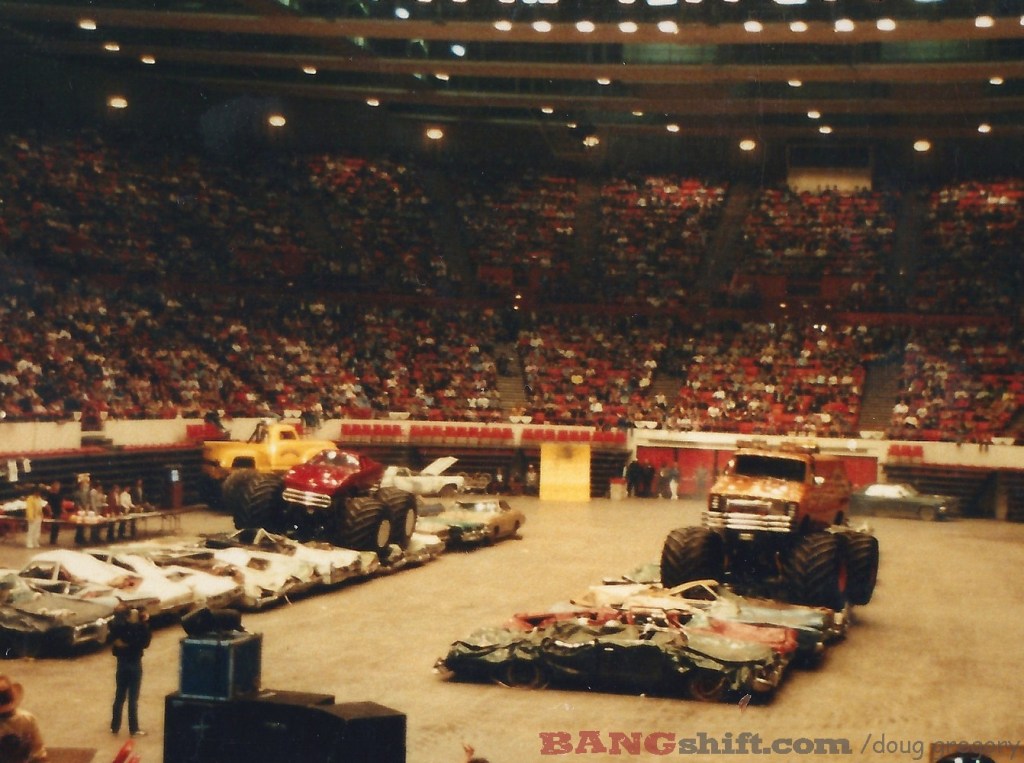
“I was pretty depressed, I was panicking a bit, I just didn’t understand why I was suddenly breaking so many damn axles,” confessed Oldaker. “My mom and step-dad lived outside Wichita at the time, so I went to stay with them for a while after the Kansas City show, spend the Christmas holiday there and all that.” Clearly suffering from despair, Oldaker had told Darryl Starbird just before the end of the show weekend in KC that he couldn’t keep running his shows if he was going to keep breaking axles at the rate he had been. Out of respect for Darryl, he didn’t want to keep breaking and potentially letting him down every show.
“Darryl was extremely kind to me,” says Oldaker. “Instead of just kicking me to the curb after all the breakage I’d had, he encouraged me to take a bit of time off at my folks’ house and just leave the truck alone for a few days. After that, he said to come back to the truck and work on it and that I’d figure out what it was. Turns out he was right, it ended up being something so stupid, so simple, but I’d just missed it in my constant hurry to replace the broken axles.”
Once again, Four Wheeler magazine decided to fly Jeff Johnston out to rendezvous with Oldaker and Rollin’ Thunder, for an updated piece that would eventually appear in the April 1985 issue of the magazine, as well as being adapted for a special monster truck-focused issue of Japan’s “4×4 Magazine”. “I had the truck parked on the trailer at my parents’ house and for some reason we had the tires off the trailer, so I had some friends help me load those up by hand and then we went and set the truck up at a nearby gravel pit for the photo shoot. Everything seemed fine on the transport tires, but as soon as we started moving the truck around on the big tires, just driving around on relatively flat ground, we broke more axle shafts. It about made me sick to my stomach.” Thankfully, Jeff was another believer in what Jim was trying to do with Rollin’ Thunder and offered him similar encouragement to that which Darryl Starbird had already offered, urging him to take a bit of time away from the truck and then come back with a clear head to determine what was causing so many broken axles.

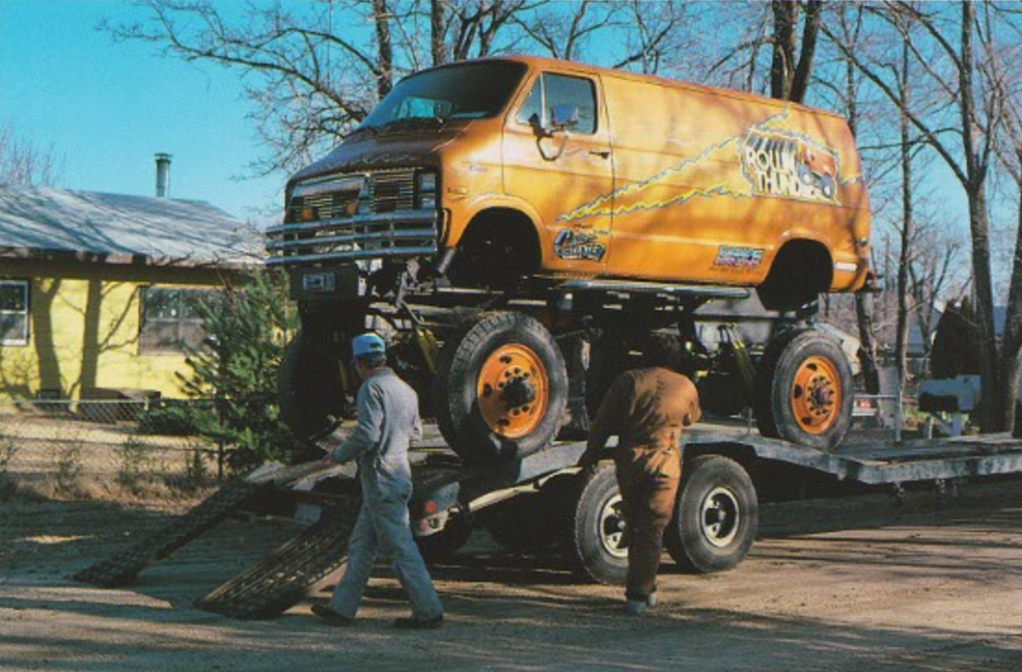
Upon disassembling the hubs on Rollin’ Thunder, Oldaker explained to me that he discovered that the studs used to secure the back of the brake drum assemblies (and the spindles) to the truck’s steering knuckles were shiny and showed signs of wear that they shouldn’t be. As it turns out, after so many repeated broken axle repairs, the studs themselves (which were threaded into the knuckle) had started to back out of the knuckle some during disassembly, and weren’t tightening fully during reassembly. This of course was putting extra strain on the bearings and outer axles which in turn was leading to so many shafts being sheared off while Rollin’ Thunder was crushing anything that ranged from derelict old jalopies to (literally) discarded soda bottles.
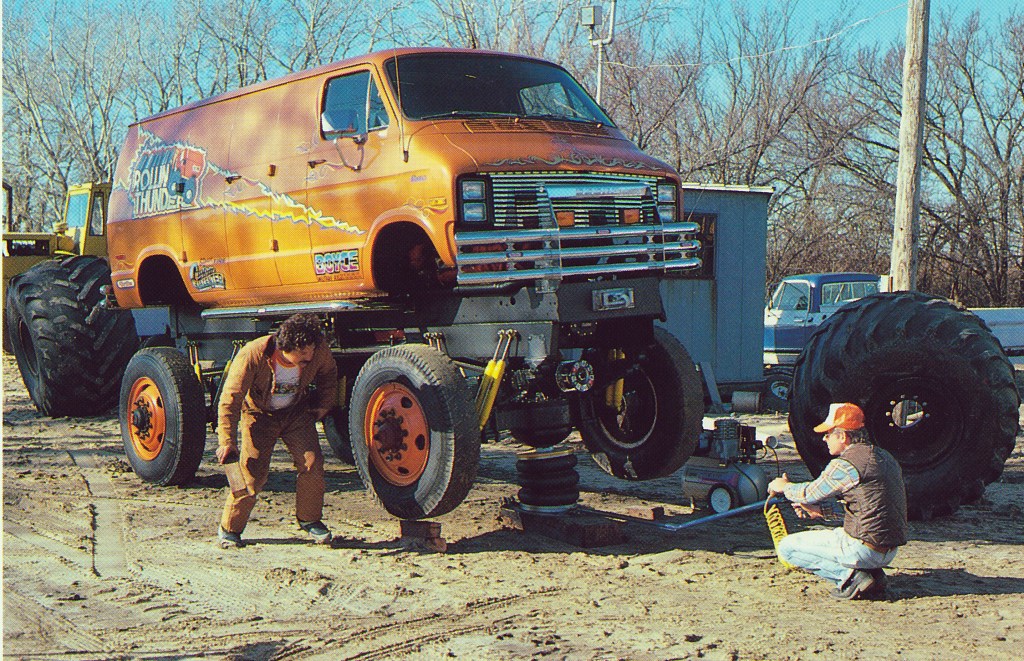
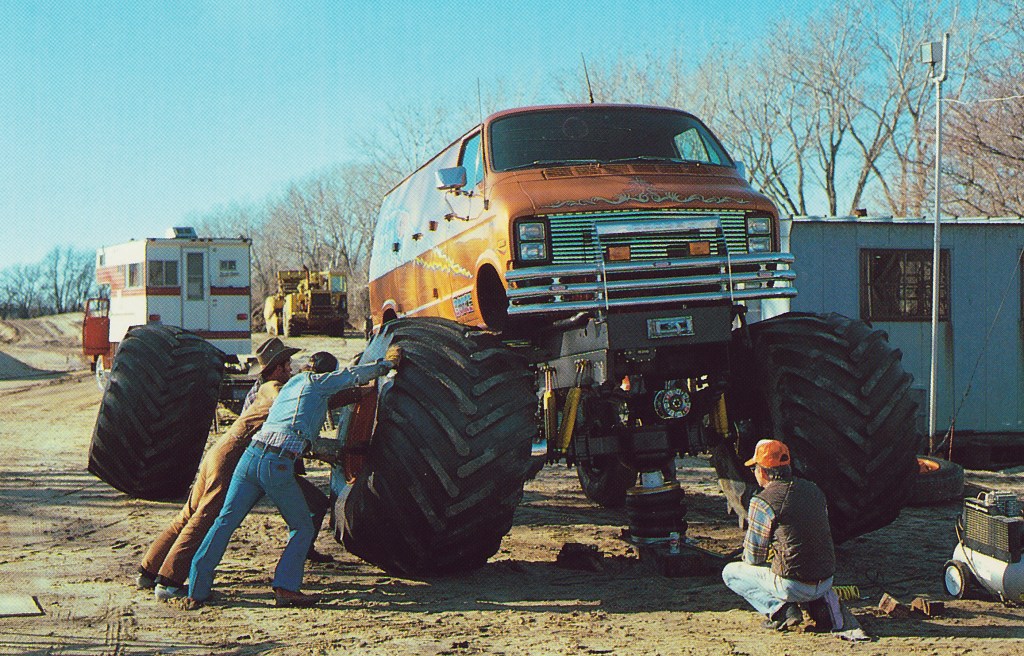
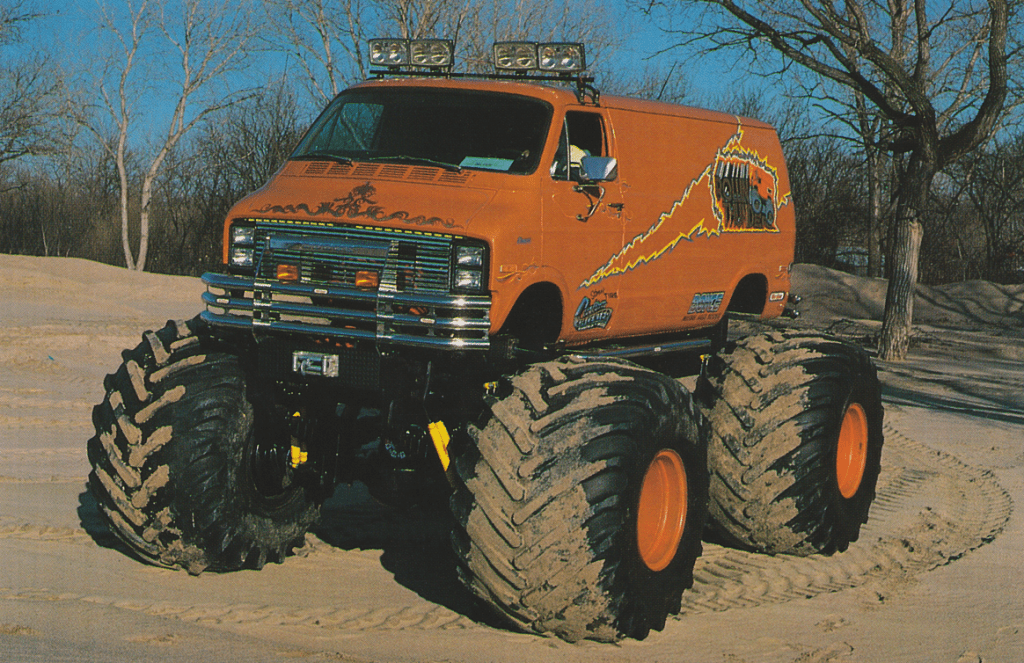
“Once we had the axle issue sorted out, that problem never really came up again as long as I didn’t try to do anything too stupid while driving,” laughs Oldaker, before continuing on to admit that “I still did stupid some sometimes. I once did an event in Phoenix with Jack Willman Sr. and his Taurus truck. He had planetary hubs on his truck by then, but the ones I’d bought to put on Rollin’ Thunder were still at home because I had no time to fit them on. Anyways, he thought he’d put on a lousy show for some reason so he asked me to do a tug-o-war with him at the end of the show to kind of redeem himself. I warned him I was going to break a bunch of axle shafts but he convinced me to do it anyways. Sure enough, I broke a whole bunch of axles but thankfully he was a good sport and didn’t drag me all over the place!” said Oldaker with another hearty chuckle.
With the axle reliability issues seemingly behind him, and a decent handle on how to drive the quirky and cumbersome Rollin’ Thunder in competitive show environments, Oldaker and his machine were now poised to make their mark on a wider audience, and not just in arenas and stadiums but in their living rooms too. Life was about to press “fast-forward” on Rollin’ Thunder’s popularity.
 The Exhaust Fumes Blog by Kyle Doyle