Rollin’ Thunder’s popularity was about to soar, thanks to huge shows, home videos and toy replicas. But could Oldaker and his machine survive life in the limelight, or would success leave as quickly as it came?
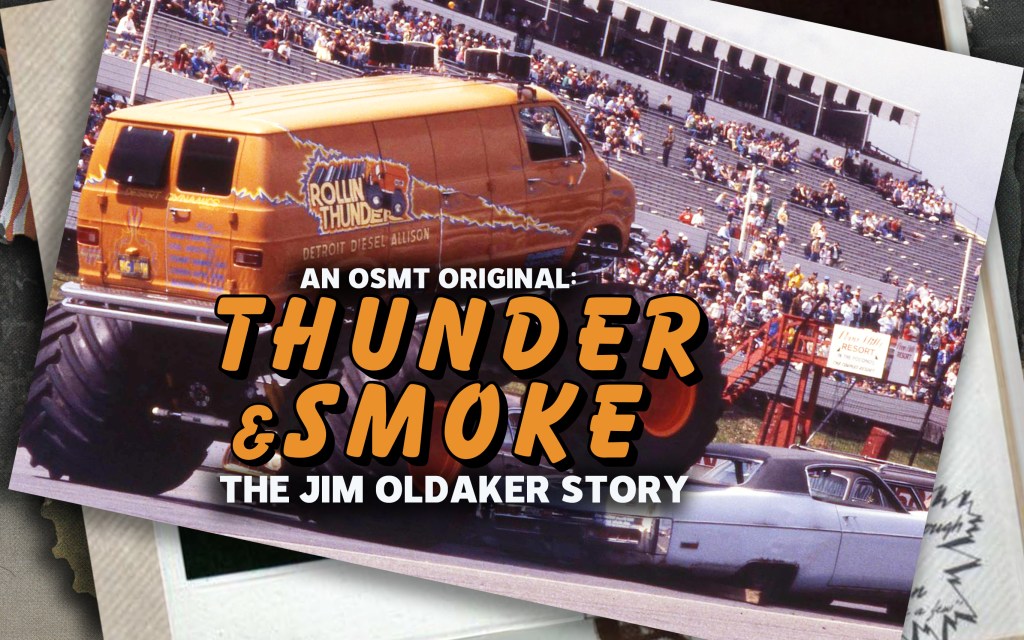
The National Stage: Oklahoma City & New Orleans – 1985-1986
There was a period of time, from the late 1970’s into the early 1980’s, that saw a videotape format war erupt between rival Japanese electronics concerns Sony and Victor Company of Japan (JVC). As early as 1974, Sony recognized that an emerging home video market was going to explode in just a few years’ time, driven by the consumer demand for the ability to watch things like feature films at home, as well as the ability to record content onto blank tapes themselves. While Sony initially led the market with their proprietary (and some would argue, far superior) Betamax (or simply “Beta”) tapes, JVC soon counterpunched with their Video Home System (VHS) tape format. By the early 1980’s, consumer belief in the VHS system for a variety of reasons would help steer both the electronics industry and the film/studio/video rental industry towards the format, leaving the Beta format to die a slow, protracted death through the 1980’s with only the Betacam video camera recording format persisting beyond the end of the decade.
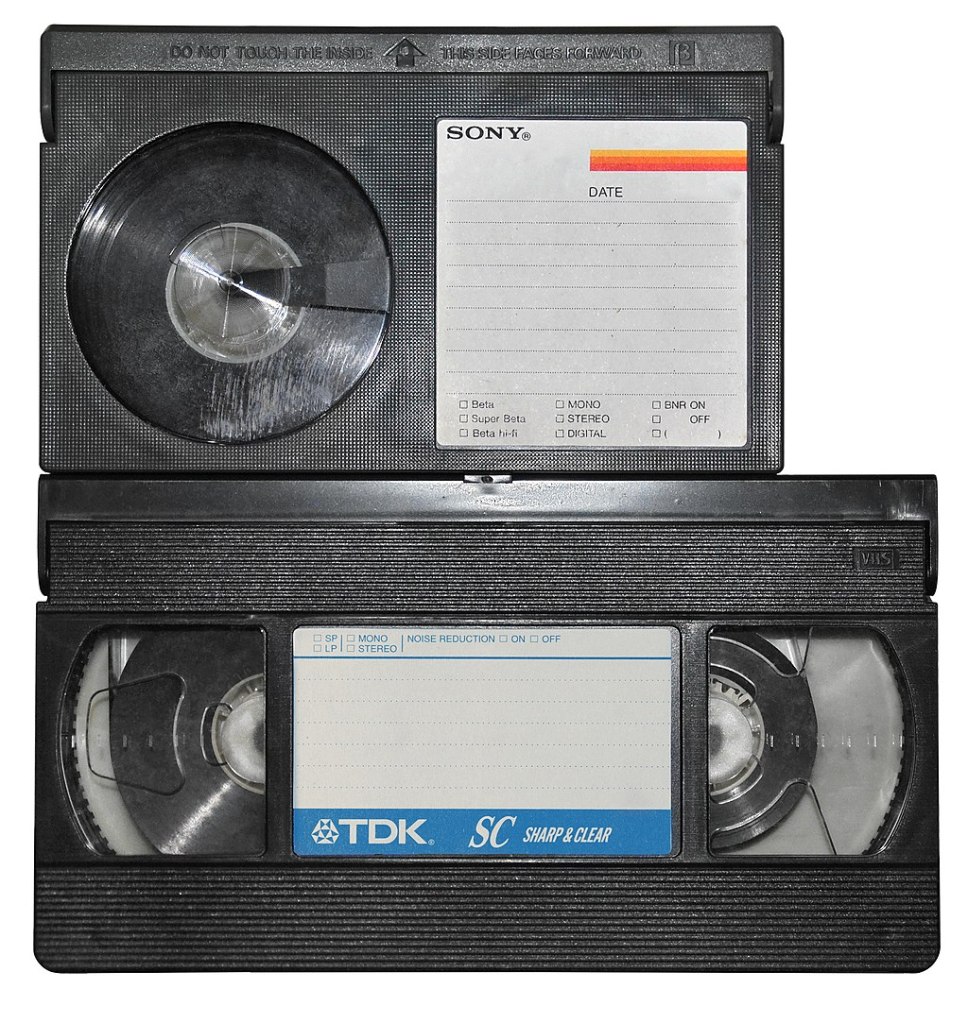
While a number of urban legends persist as to how and why the VHS rose to dominate the home video format (until the arrival of the DVD near the end of the century), including the theory that the adult video industry pushed for VHS over Beta, the one fact that cannot be denied is that the monster truck industry did a pretty fair job of cashing in on the exploding home video market during the 1980’s. And right in the thick of it, at least at the start, was Jim Oldaker and Rollin’ Thunder.
In an effort to capture the zeitgeist of the monster truck industry and its blossoming popularity, Chicagoland-based TV producer and motorsports announcer Jan Gabriel and his TV-One production team set out in 1985 to create a three-part TV special about monster trucks and monster truck-adjacent competitions. While perhaps not widely known outside of the motorsports industry, Gabriel was something of a media legend in the business. Credited with developing the now famous/infamous “Sunday! Sunday! Sunday!” phrase in radio ads for US30 Drag Strip in Hobart, Indiana, Gabriel also played a huge role in helping increase the public’s greater awareness when it came to motorsports in general, particularly drag racing, stock car racing and monster trucks.
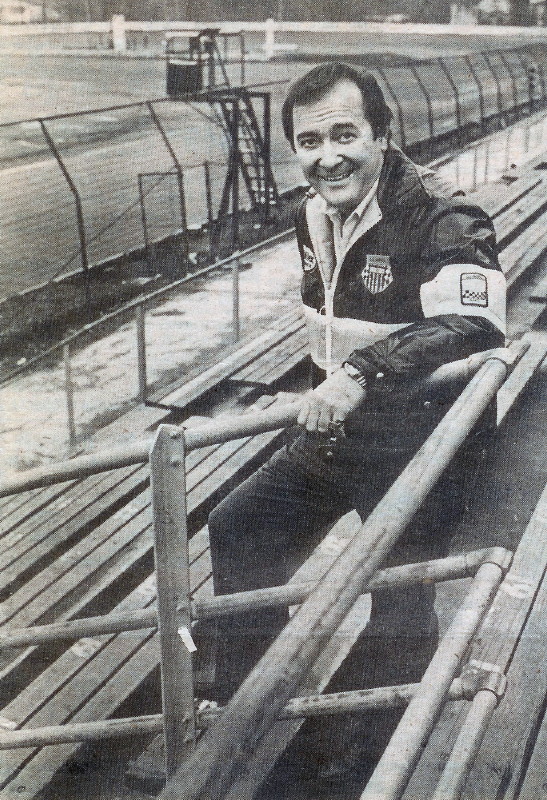
Gabriel accomplished much of this via his syndicated TV show “The Super Chargers”, a sort of motorsport and automotive variety show that allowed him to expose viewers to things like monster trucks in an exciting and compact half-hour format. But as the public became increasingly interested in monster trucks, Gabriel saw the opportunity to deliver multiple long-form, made-for-TV specials that could quickly be sold as home video releases on VHS and Beta. Gabriel would host the specials himself, augmented by variety of notable sports and entertainment personalities (Jack Arute, Steve Evans, Judy Landers) as well as at least one confusing one (Claude Akins), all of whom were aided in their entertainment efforts by a quintessential 80’s stock-music soundtrack and a barrage of almost-cutting-edge video effects.
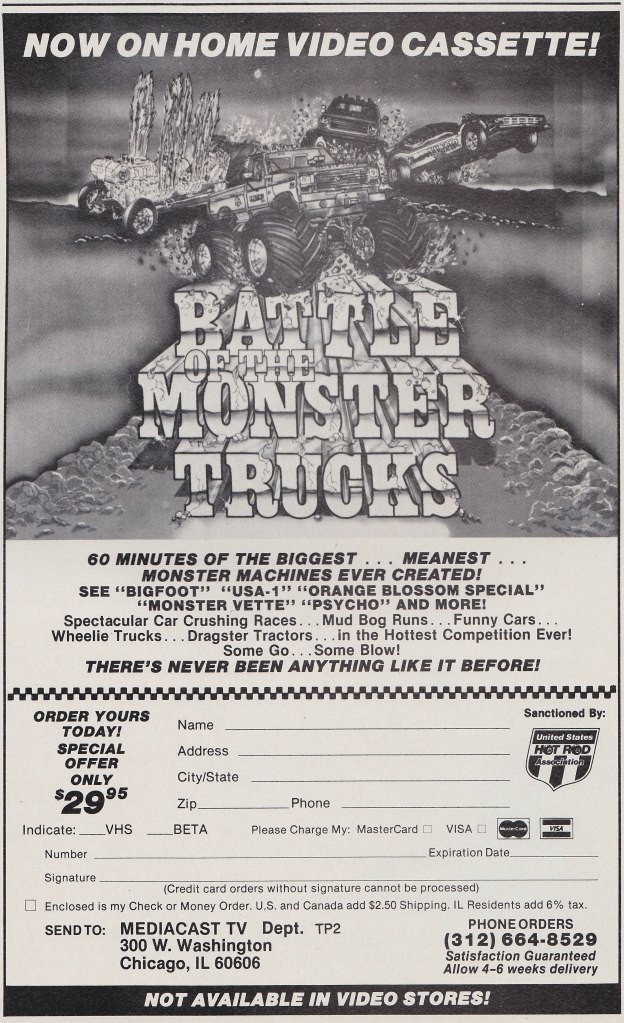
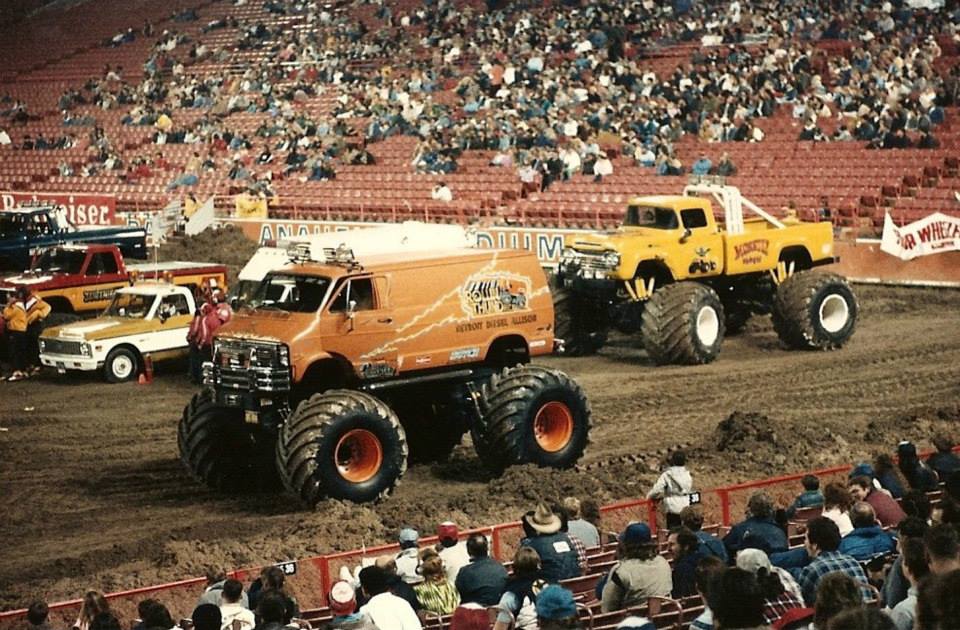
Each of the specials (and their subsequent home video releases) performed exactly as designed and were relatively lucrative hits, with Oldaker and Rollin’ Thunder featuring prominently in all three of the iconic episodes, which were titled “Battle Of The Monster Trucks”; “Return Of The Monster Trucks”; and “War Of The Monster Trucks.” In “Battle Of the Monster Trucks”, Oldaker and Rollin’ Thunder appear as an up-and-coming duo at a Darryl Starbird event inside Oklahoma City’s Myriad Center, competing in what has to be considered some of the very first side-by-side monster truck racing against the likes of contemporaries like “Monster Vette” and “Frankenstein” (owned by Darryl’s son, Cliff), as well as Pac-Northwest wild man Mike Welch and his “Monster Mash”.
“The van always did pretty good at the Starbird shows,” recalls Oldaker. “First gear in the transmission was a granny-low gear, so I would just do everything in second gear since third gear was way too tall and the truck would fall out of its powerband during the long shift from 2nd to 3rd. So once I got up on the cars, I could just hold it to the floor and plow ahead to the finish. As long as I didn’t have to lift for anything, the truck would hold its own pretty well.”
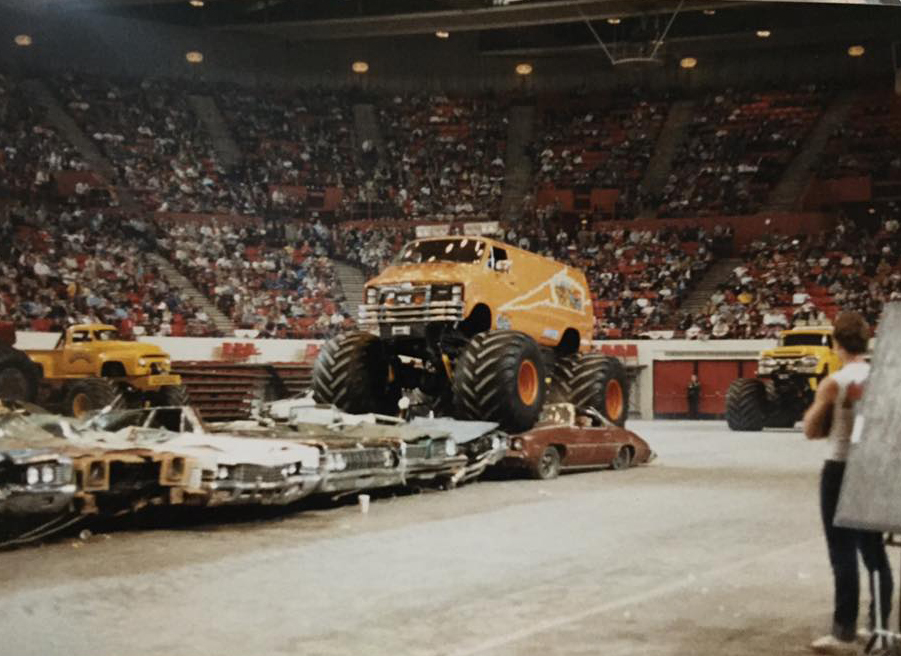
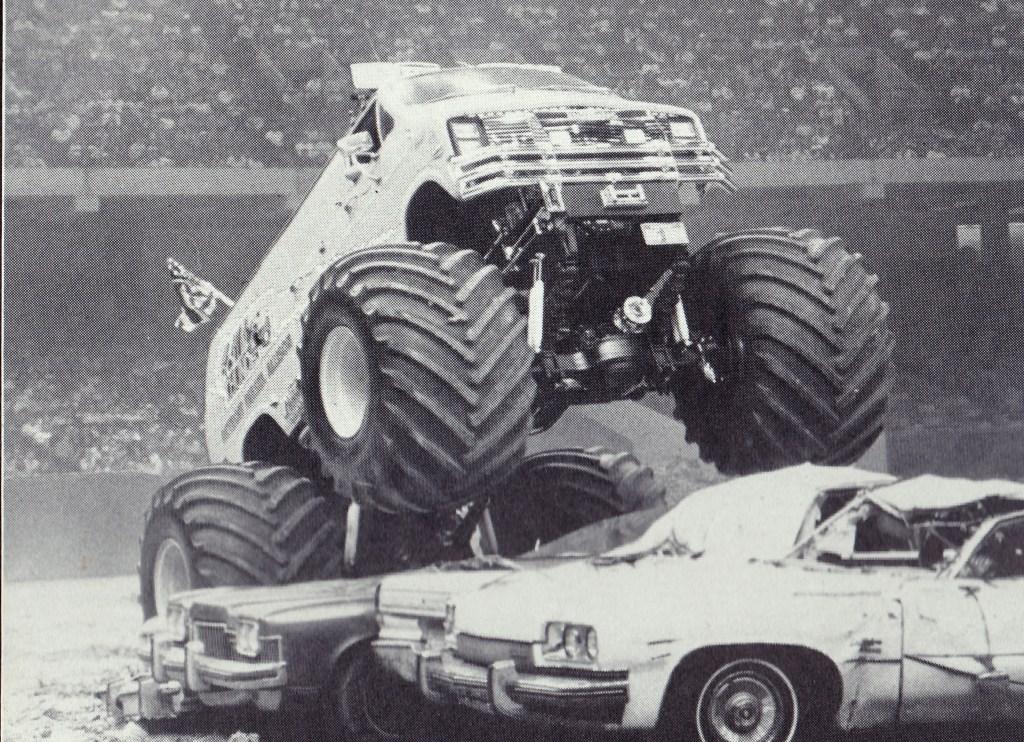
Gabriel’s three-part series of specials featured footage that, while legendary among monster truck fans, didn’t always follow in any real chronological order, one example of this being the aforementioned Oklahoma City event. While Oldaker was shown competing at the OKC event in the first installment of the series, a stunt he agreed to perform with an escape artist at the very same event wasn’t shown until the third installment’s release in 1986. Oldaker’s stunt featuring the escape artist may have been among the first “man vs. monster” type stunt-gags performed, but it certainly wouldn’t be the last. I asked Oldaker how he found himself being coerced into performing as part of the act, which featured Rollin’ Thunder crushing a pair of cars placed lengthwise in front of the truck, one of which contained the escape artist in the back seat.
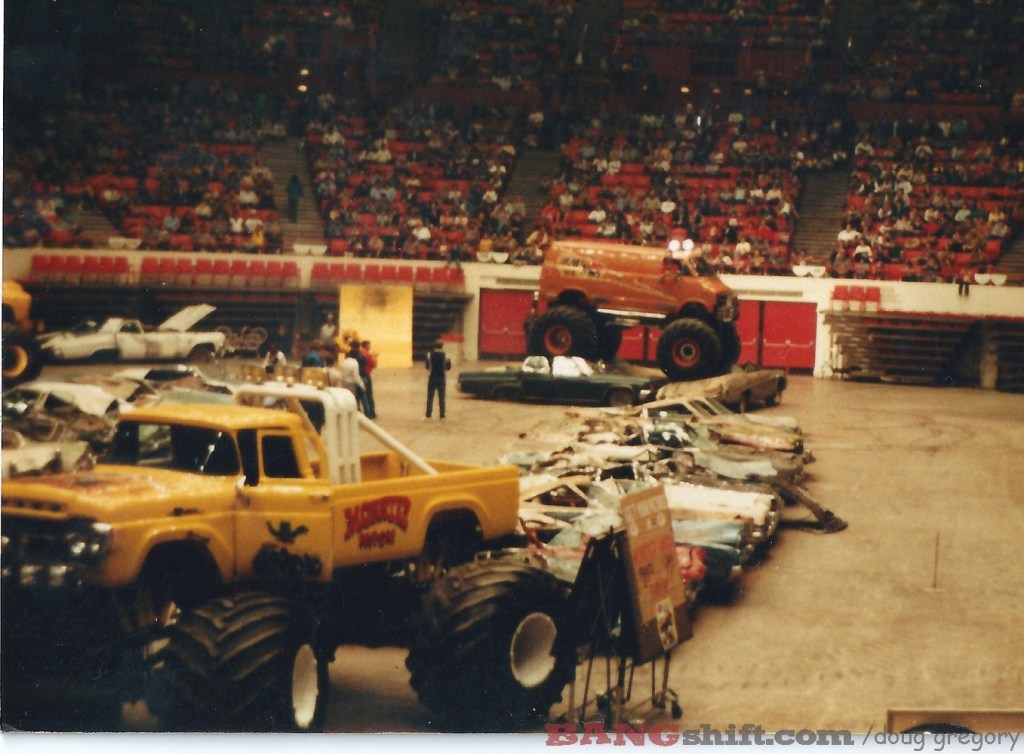
“So this magician guy they had, he had an escape artist routine and everything with the Velcro straight jacket and all that stuff. He would get all bound up, then they would shove him in the back seat of one of the fresh crush cars that they had blacked the windows out on, so the people couldn’t see him getting out of this jacket and stuff. Anyhow, the magician and Darryl (Starbird) wanted me to do the act with Rollin’ Thunder because of how heavy the van was, and how tall and impressive it looked to the crowd. It was kind of scary for me back then even though I knew every step of the deal ahead of time. You’ve gotta remember, I was still pretty new at driving back then and that van was HEAVY!” said Oldaker, with an amused chuckle.
“It was also kind of scary because they would throw this guy in the back seat of the car that the passenger side of the monster truck would be driving over, so I really couldn’t see any of what was going on below. They’d just have someone like Cliff (Starbird) standing where I could see him, and when the time was right he’d give me a sign and I’d just throttle hard up on top of the cars. The thing was so heavy, it would buckle the roof of the cars with just the front axle, I didn’t even need to drive all the way over. I was so apprehensive about the doors getting jammed shut on the car, or the car caving all the way in.”
But while Rollin’ Thunder’s performances in “Battle Of…” and “War Of…” were both impressive and entertaining, the truck and it’s owner/driver would truly cement themselves into the hearts and minds of monster truck fans young and old with their appearance in “Return Of The Monster Trucks”, inarguably the finest release in Jan Gabriel’s three-part monster truck opera. Built entirely around the United States Hot Rod Association (USHRA) sanctioned event held at the Louisiana Superdome on January 11th of 1986, “Return Of The Monster Trucks” stands to this day as perhaps the single-greatest monster truck video releases and documents one of the single-most important events in the sport’s history. Through this special/home video, fans were introduced to a plethora of the sport’s unique personalities and their equally unique monster creations. In fact, long-time monster truck stalwarts like Bigfoot and USA-1 seemed relatively blasé compared to the radical looks and layouts showcased by Rollin’ Thunder (a bright-orange diesel-powered van), Blue Thunder (a blue Camaro on hydraulic shocks controlled by a helicopter joystick), and Awesome Kong II (a stepside late-model Ford truck with an Allison V-12 aircraft engine in the bed for power.)
The trucks would compete against each other, paired off in a bracket-type format with a multi-discipline obstacle course standing between them and TV glory. Billed as “the first national side-by-side monster truck race”, the competitors would take the green via a drag racing-style Christmas tree placed between the two tractor pulling lanes, each truck hooked to a weighted pulling sled for the first leg of the course. Upon taking the green, the drivers would hammer down as hard as they could until they reached about halfway down the pulling lanes, call it 100 to 125ft, give or take. After being unhooked by a crew member on the ground, the trucks would then accelerate down the remaining length of the pulling track before executing a criss-cross turn, alternating from the inside lane to the outside lane or vice-versa. Immediately after executing the risky crossover move, drivers then had to coax their machines up a nearly six-foot-high dirt hill followed by a lengthy set of crush cars that proved to be more than tricky for a number of the competitors. Still, even after all of that, the finish line would remain out of reach until the drivers had each negotiated a small mud pit backed with two additional crush cars, the first truck to land back on all four tires being declared the winner.
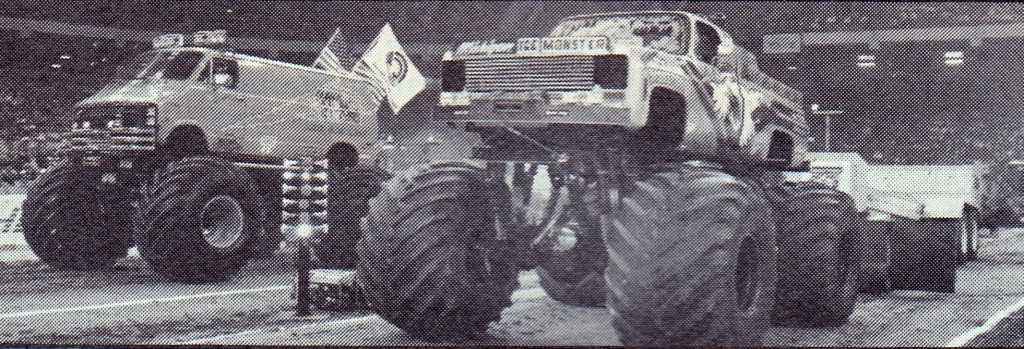
By the end of the Superdome event and thusly the special as well, legendary wheelman Jim Kramer and BIGFOOT IV reigned supreme atop the field of competitors, defeating long-time rival Jeff Dane in Awesome Kong II in a thrilling heavy-weight final round that undoubtedly changed the course of the sport’s future. Oldaker and the lumbering Rollin’ Thunder struggled in the first round of competition and were narrowly dispatched by an equally cumbersome competitor in the form of Brett Engleman’s “Michigan Ice Monster”, each truck and driver hard-pressed to finish the course in under a minute and a half. Sadly, Oldaker’s first-round time was an interminably long 81.10 seconds, but having learned so much about the challenges of driving Rollin’ Thunder from hearing Jim’s stories, I’m inclined to grant him more than a little grace when reevaluating the van’s performance nearly 40 years later.
“Well, it wasn’t the best course for Rollin’ Thunder, let’s put it that way,” admits Oldaker. “Like I mentioned, the truck ran well in 2nd gear if you stayed in the throttle, but a track like the one in the Superdome at that show was tough because I had to get in and out of the throttle a lot. When a 2-stroke Detroit falls out of its powerband, it’s a slow recovery.” Oldaker navigated the sled pull rather well despite the powertrain challenges Rollin’ Thunder was beset with, but his ground crew member was slow getting the big Dodge unhooked from the sled and sacrificed most of the gains he’d made during the pull. Oldaker didn’t hold back heading through the crossover turn and charged the dirt hill without fear, letting the van’s bulk and the Detroit’s torque carry the surging leviathan up and over the pile of packed earth without so much as a whimper. As Rollin’ Thunder’s front wheels slammed back to earth after carrying a wheelie over the top of the earthen berm, Oldaker set his sights on the relatively fresh set of junk cars that next stood in his way, but that is when things started to unravel for the young Californian.
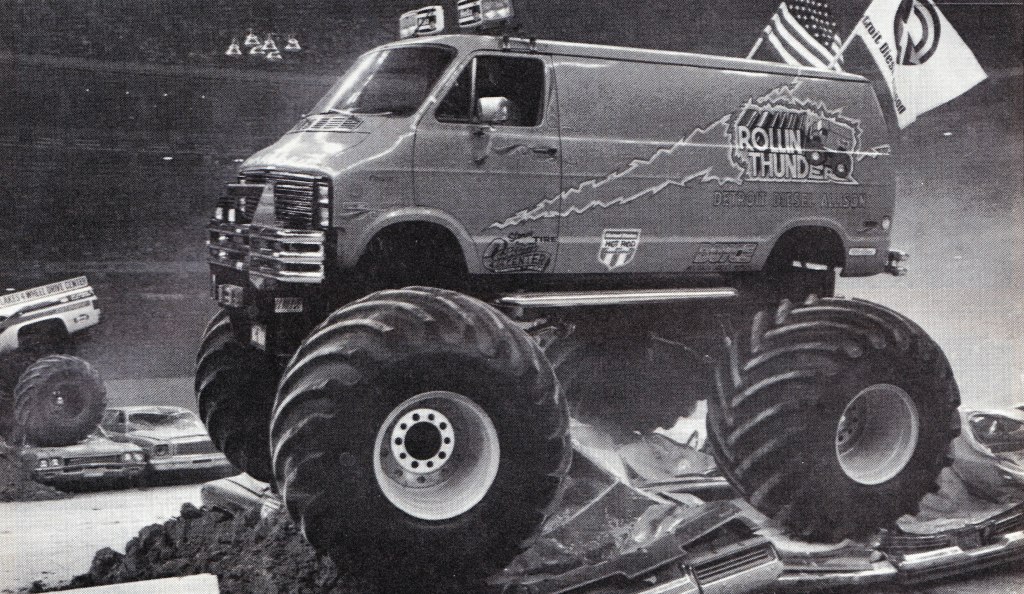
Slowing to very nearly a complete stop to gather himself and possibly to downshift to low-gear (Oldaker couldn’t recall for certain, and the video makes it impossible to tell), Oldaker then charged Rollin’ Thunder up onto the cars, still well ahead of Engleman’s Michigan Ice Monster. Suddenly though, the big van began to drift to the left-hand side of the cars, possibly due to the rear steering being slightly off-center, a situation that threatened to slide the van right off the cars and derail the entire run. Oldaker made the tough call in the moment to stop and reverse atop the cars, in an effort to realign the struggling beast and gear up for the final push to the finish line. The Ice Monster by now had gained a narrow advantage heading off the set of cars and towards the mud pits, an advantage that ultimately would be maintained despite Oldaker’s best efforts to play catch-up. And while it might seem that Oldaker would have been so devastated by the experience of watching a potential first-round win slip through his fingers, the truth was that he was simply just happy to be there.
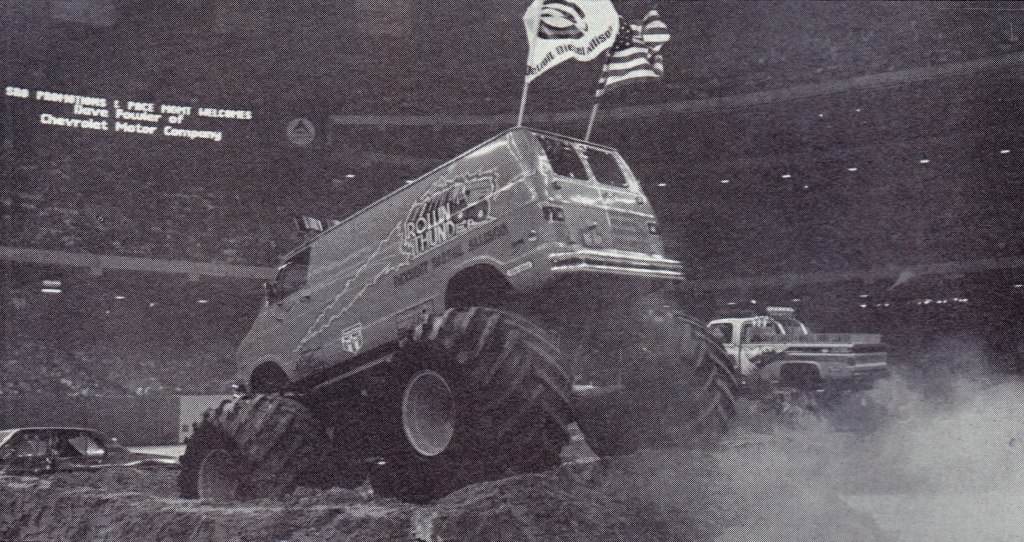
“I didn’t pull the truck outside or leave the building or anything,” explained Oldaker, when I asked him how he handled the loss. “Like I said, it just wasn’t the best course for Rollin’ Thunder. But I stood with Bob (Chandler, Bigfoot owner) and Everett (Jasmer, of USA-1) and we watched the rest of the races. I’d been running a lot of USHRA events by then and had become friends with Bob, and really we were just watching Jim (Kramer) run his butt off all night long.”
It has been insinuated countless times before by this author and many others that Kramer’s final-round run against Jeff Dane’s Awesome Kong II really constitutes the greatest single monster truck race of all time, even to this day. And when I offered up that opinion to Oldaker, I could all but hear him smiling through the phone when he said “Jim wasn’t going to lose. He just wasn’t. Awesome Kong did a good job, but it was heavier, had a shorter wheelbase than Bigfoot, but as I was standing there with Bob I just knew that Jim wasn’t going to lose, whatever it took.” By the end of the night, Oldaker knew he’d participated in and witnessed a truly special event, but he admitted to me that he didn’t fully grasp the magnitude of the night’s events.
“I knew it was a big event, kind of a big deal with the film crew and all, but I had no idea the reach that particular show was going to get. Things started to really change after that.” And truly, they did. Rollin’ Thunder’s popularity continued to grow at a seemingly exponential rate, and the truck became a familiar sight inside domes and stadiums and at major race tracks around the country. The notoriety came in waves, the payouts were as good as they’d ever been, and the Matchbox toy company had even immortalized Rollin’ Thunder with a toy of its own.

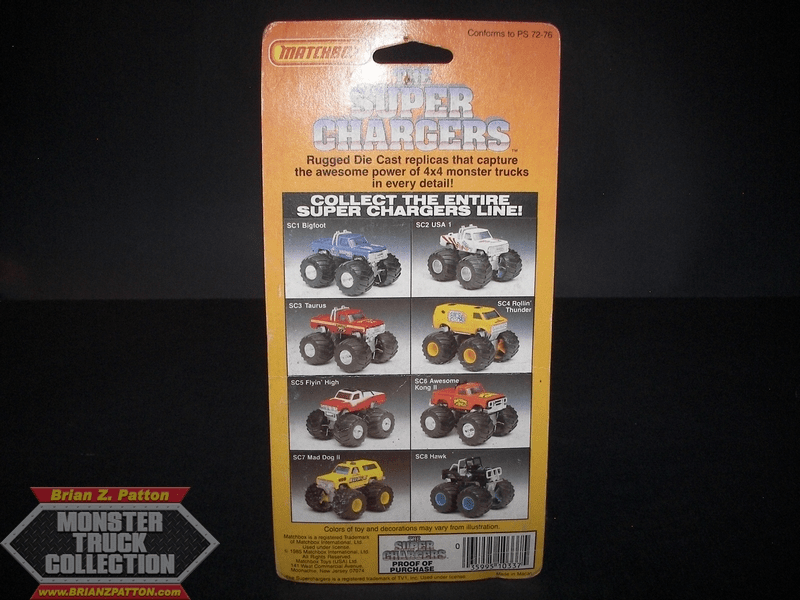
“Jan Gabriel helped put the SuperChargers toy line together with Matchbox, and he set the whole deal up so Rollin’ Thunder was part of that. He was a great guy, I liked him a whole lot,” said Oldaker. I asked him how it felt signing autographs for kids all over the country who were holding toy replicas of his monster van, and he replied that “It was awesome when we started coming back to the same places year after year, and kids would come up holding a toy of my own truck, wanting an autograph. I think we bought the trucks at cost, so it’s not like we got a huge discount on them or anything, and we didn’t get a bunch of royalties off of them or anything like that. It wasn’t even a Dodge van, the toy, and it had porthole windows with of course the real van didn’t have,” says Oldaker, clearly still proud of the fact that a Matchbox Rollin’ Thunder once existed.
“So you’d say they were a pretty popular item back then?” I asked. Oldaker replied with a laugh and a smile:
“We sold the shit outta those things!”
Blame It On Bob: New Orleans, Anaheim – 1986
I want to take a moment in all of this to share a really interesting story that Oldaker recalled during one of the many phone calls it took to capture the details of this man’s journey. As best as I can put together, this story starts during load-out, after the “Return Of The Monster Trucks” show in New Orleans wrapped up in January of 1986 and continues a couple weeks later at the USHRA event in Anaheim, CA at The Big A.
One evening while talking with Jim via text, he tells me that “you need to remind me to tell you the story of when I ran myself over with Rollin’ Thunder, the next time we’re on the phone.”
Well, that’s certainly a sentence.
So of course, that was at the top of my list of things to cover with him during one of our final phone chats late in the writing of this story. This story is pretty funny now, considering nobody got hurt (at least not too permanently) and we’ve got almost 40 years of hindsight with which to consider it. In the moment, however, I think it really does make you realize not only how fearless the early crop of monster trucks were, but also perhaps how little they considered about the danger a monster truck could present if handled incorrectly, especially in the days before remote ignition interrupter (RII) systems.
“So, this was all Bob Chandler’s fault!” Oldaker laughs good-naturedly. “I blame it all on Bob, it was his idea after all. So after one of the New Orleans shows at the Superdome, I can’t remember which one it was, but there wasn’t a lot of extra room inside for everyone’s rigs after the show, so us monster truck guys were just waiting around for our turn to bring our haulers in so we could tire down and load up. I was like, the last one in line and I was getting kind of bored as the night drug on. So just for laughs to entertain myself, I fired up Rollin’ Thunder, cranked the front and rear steering, put it in low gear and let it just idle around in a slow circle. And then I climbed up on the roof of the van and hung out, just sat around while it idled in a circle!”
He’s laughing pretty good at this point, and I’m laughing too but I’m also staggered at the brazen audacity to do something like that. Yes, yes, we’ve all seen Kramer doing the tire walk in a multitude of different Bigfoot trucks. But this just seems absolutely crazy to me, to casually just try something like that. We both might have been monster truck drivers in our younger years, but we very clearly came from different eras in the sport!
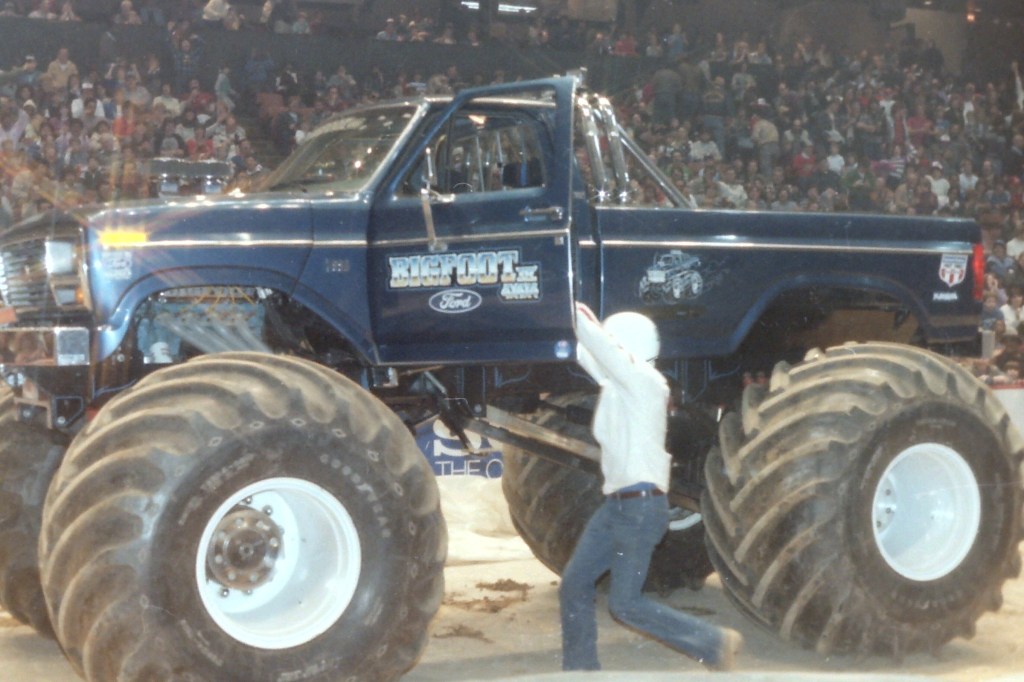
Continuing his story, Oldaker tells me what Chandler thought of his newly-developed trick: “Bob thought it was great! He told me I should incorporate that into my act, when I was doing car crush exhibitions and stuff. I wasn’t so sure about that, but on the drive back west I sure thought about it a lot.”
A couple weeks later we were at another show in Anaheim, back when we did two-day shows there. It had rained overnight or early in the morning and it was a muddy mess down in the stadium. Bob asked if I’d seen Kramer doing his tire-walk routine with Bigfoot at other shows before, and suggested I should give it a go too since my truck could idle around really slowly in a circle and everything. Kramer was smooth as hell doing it with Bigfoot so I don’t know why I thought I was going to be able to do the same.” Oldaker’s voice changed some as he spoke that last sentence and I got the idea that what happened next wasn’t going to be great.
“So, I pulled the van up out of the stadium into a vacant parking lot, put it in low gear and did the tight-turn thing again with it like I’d done in New Orleans. I hopped out and came around to one of the rear tires and tried to ride it up like Kramer was doing back then. But of course the tires were wet and muddy and I was wearing rubber rain boots, and my feet slipped pretty much instantly. The tire just grabbed me and threw me to the ground, kind of into the fender well and just right down onto the ground so fast I couldn’t do anything about it.” Now I’m stunned that he’s still here to talk about this incident, dreading what was coming next in the story.
“It ran my right leg over, right below my hip, and it hurt like hell. I mean man, did it hurt! It was scary, but as soon as the tire rolled off me I hobbled up as best as I could and killed the motor. Detroit Diesels like Rollin’ Thunder had, they had an emergency shut-off switch on the blower that would choke the motor off and kill it. I could get to that switch really easy on Rollin’ Thunder from the ground so that’s how I got the truck to stop. I was starting to feel a lot of pain in my leg and side, I was kind of mad and embarrassed and I hobbled back to my bus as best I could and tried to lay down.”
“I pretty much knew I wasn’t going to be able to drive the show that night, considering I could barely make it up into my bus. Bob and his guys eventually noticed the van sitting by itself in the parking lot and came over to my bus to see what was up and they found me there in a lot of pain. I ended up agreeing to go to the local hospital to get X-rayed to make sure I didn’t have anything broke, and somehow I didn’t. Bob felt really bad about it and offered to drive the van in the show that night to help me out,” Oldaker explained.

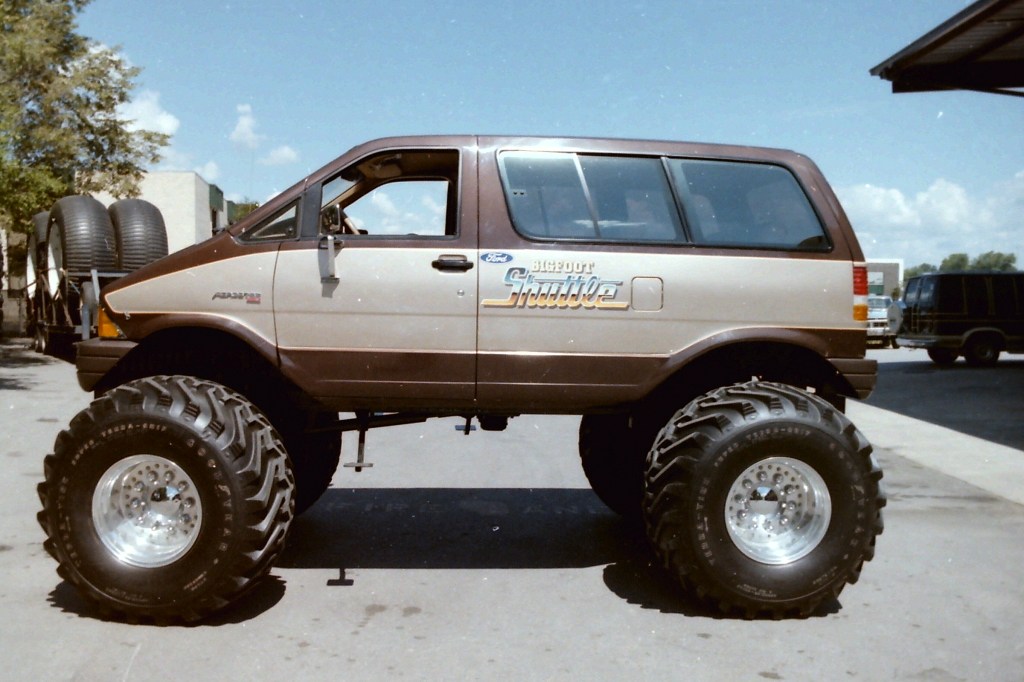
“But that thing was a bear to drive, and honestly I didn’t want Bob driving my truck!” Oldaker said with another laugh. I’m guessing that choice had 50% to do with the difficulty of driving the van, and 50% to do with Bob’s “big foot” reputation. Thankfully I had been training my friend Pete Wickerham, an expat from England living in California, to drive Rollin’ Thunder with the idea that we’d eventually have two trucks on the road. So slapped a black helmet on him and he was able to get the truck through the show. There was no way in hell I was going to be able to walk down into the stadium to watch the show, so Bob and one of his guys, George Link, loaded me up in the Bigfoot Shuttle van and gave me a ride down into the stadium. George was doing his best but man, every single bump he hit would just shoot pain through my leg, which was swollen damn near twice its size.”
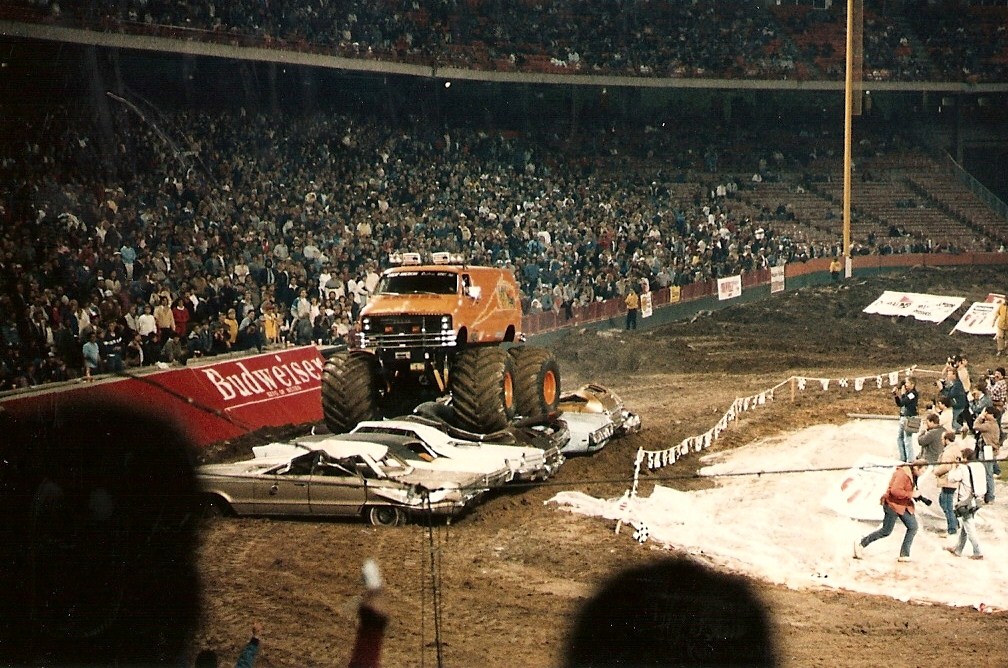
I point out the obvious to Oldaker, that being the fact he’s supremely lucky that the truck didn’t cause greater, more….permanent injury, to him, especially given the sheer bulk of Rollin’ Thunder. He replied that “I’m lucky it was the ass-end that ran me over because all the weight was mainly in the front, so really all I got was that giant bruise and some swelling,” before tying a perfect bow on this particular anecdote:
“No point in being stupid if you can’t show it off!”
Obsolete & Incomplete: Detroit, Anaheim, St. Louis – 1986 – 1987
Legendary monster truck announcer and TV commentator (and another Oklahoma-based personality) Mike Gallaway summed up Rollin’ Thunder for me pretty succinctly when I asked him if he had anything to share about Rollin’ Thunder from his days calling shows.
“The fans loved the van,” said Gallaway. “It was always really nice and clean, always looked good when I saw it. But it was big. Big and slow.”
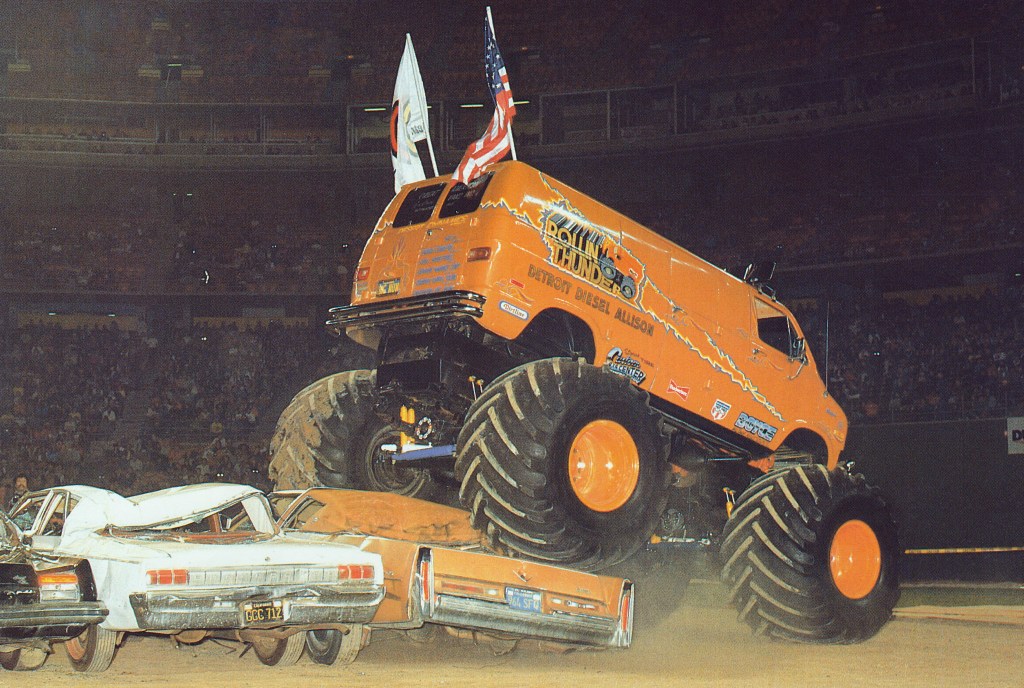
Big and slow, perhaps, but also notable and beloved. So notable and beloved, in fact, that in 1987, Japanese scale-model and remote-control car concern Tamiya released a two-wheel drive electric remote-control version of Rollin’ Thunder dubbed “Vanessa’s Lunch Box”. Visually, the truck was a damn-near doppelganger of Rollin’ Thunder and to this day is a cult-favorite in the overlap of monster truck and R/C enthusiasts. “Nope, no licensing deal for that one,” says Oldaker. “I wish they would of got ahold of me, because its clearly Rollin’ Thunder. I would have loved to let them use the name.”

While Rollin’ Thunder may have been competitive enough to hang with more “conventional” monster truck competitors in early 1986, by mid-year it was clear that no amount of clever driving or plucky determination from Oldaker could make up for how far the van had already fallen behind the times. Rapidly evolving technology on the mechanical side of things coupled with increasingly brazen, aggressive driving styles (led by people like Jim Kramer, the Dane brothers, Dennis Anderson and others) had altered the public’s expectations for what a monster truck could and should do at an event. And for Oldaker, it was growing nearly impossible for him to meet these demands with what was now a dino-era machine by contemporary standards. Still, he had to make a living somehow.
“Early on, after we’d sent a lot of our Rollin’ Thunder packets out that Joyce made, we got contacted by the Detroit Diesel Allison (DDA) folks, and they had us fly out to Detroit to see what we could do with regards to setting up a sponsorship relation. We presented them with our offer, kind of laid out what we were wanting, and they really jumped on it,” Oldaker explained.
“As part of the deal, they wanted us to appear at a number of Great American Truck Race series events, which were diesel semi-trucks racing around big oval NASCAR tracks like Atlanta and Pocono. They had us do that for two seasons, and they paid us really well to do those, something like $4500 per event plus a dollar per mile for travel. Plus, we got to keep 100% of our novelty sales, which was pretty huge! As popular as monster trucks were becoming and the fact that Rollin’ Thunder was diesel-powered really helped.”
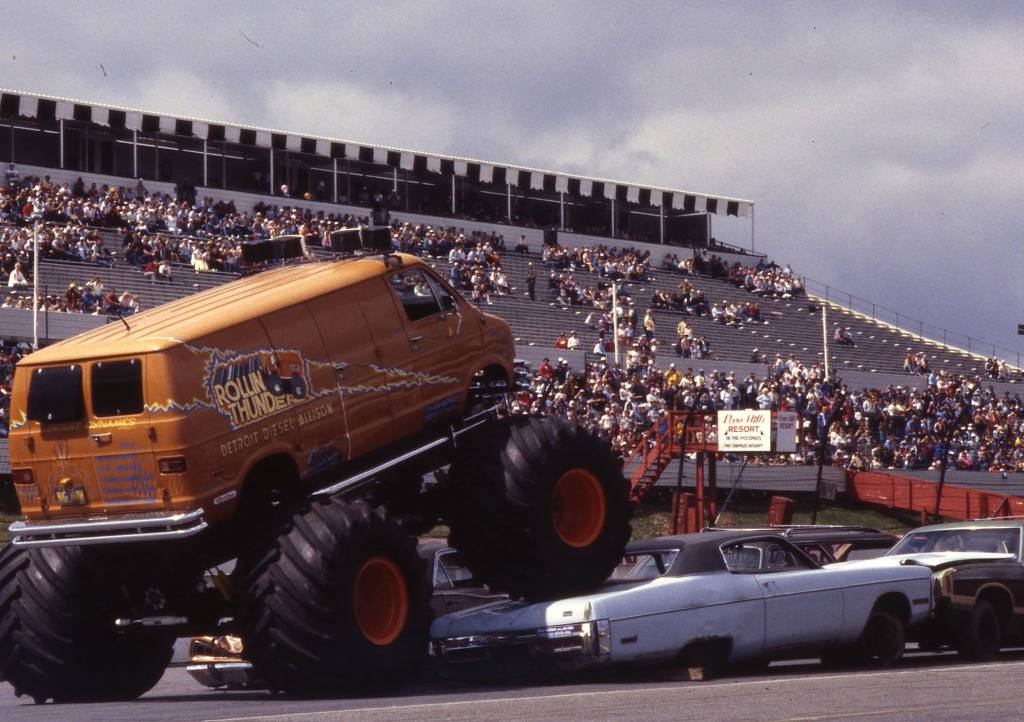
In 1970, GM aligned two of its closely-allied properties, Detroit Diesel and the Allison Division, forming the Detroit Diesel-Allison Division of GM, or simply “Detroit Diesel-Allison” for short. This combination would survive until late 1987, when a majority ownership of Detroit Diesel was sold off to Penske Corporation and its head Roger Penske as part of a joint-venture with GM. Meanwhile, Allison’s gas-turbine division had been sold off in 1983 leaving Allison to rebrand itself in late 1987 as Allison Transmission Division of GM. But for a short window of time just before the end of 1987, Detroit Diesel-Allison’s involvement in American diesel-powered motorsports was surging and Rollin’ Thunder was a significant part of that.
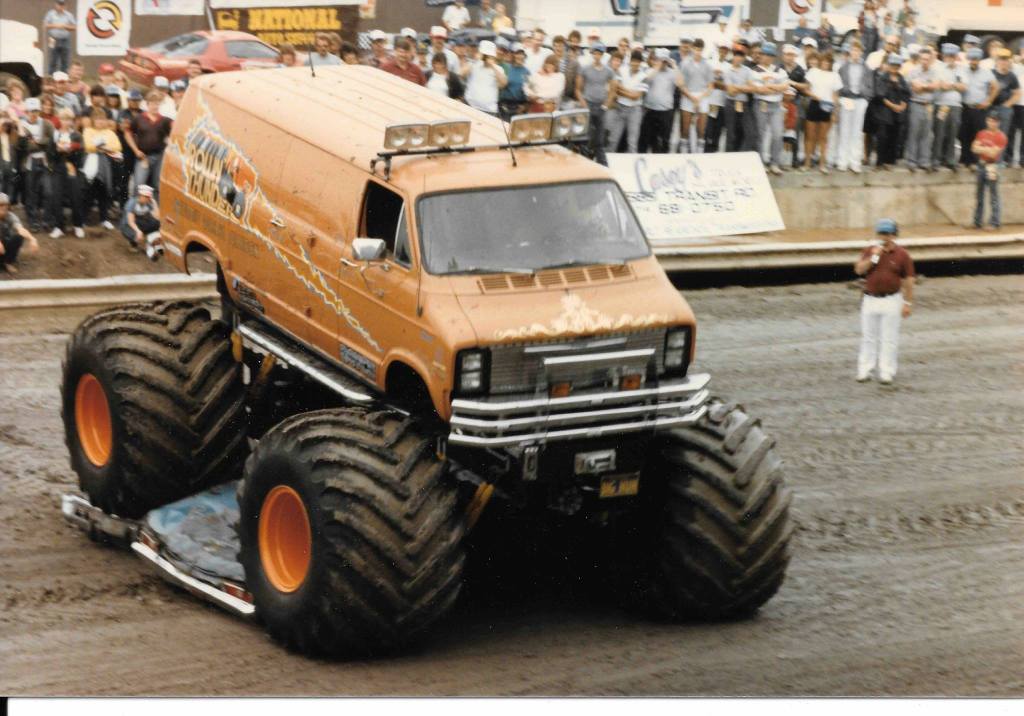
Because of Allison’s reputation as a heavy-duty automatic transmission maker, many TV commentators incorrectly stated that Rollin’ Thunder utilized an Allison automatic transmission, while in fact it never did; but that wasn’t for a lack of effort on both Oldaker and Allison’s part. “DDA gave us a lot of equipment to use, that we just never had the time and the proper shop equipment and space to install,” admits Oldaker. “They gave us a brand-new Detroit 8V-92T turbodiesel to put in our second truck, Rollin’ Thunder 2, which we had started to build by then, plus an Allison automatic for both monster trucks as well as a new turbodiesel engine for the hauler, but we never had time to put any of that stuff in. I had planetary axles for Rollin’ Thunder and for the new truck we were trying to build, but they never got installed on the original truck because we were on the road so much,” laments Oldaker.
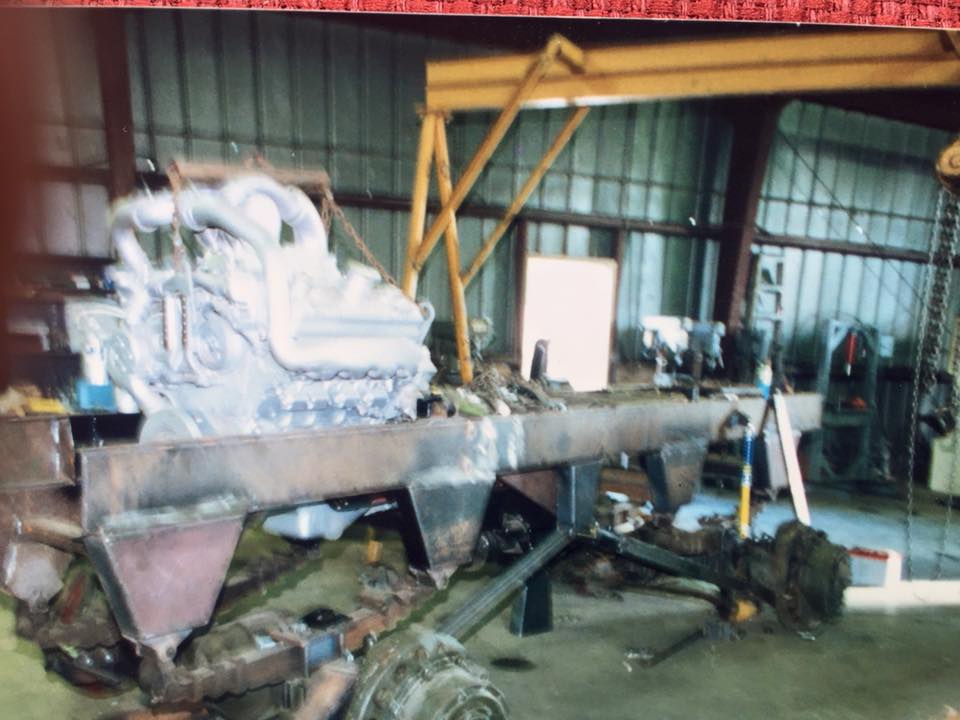
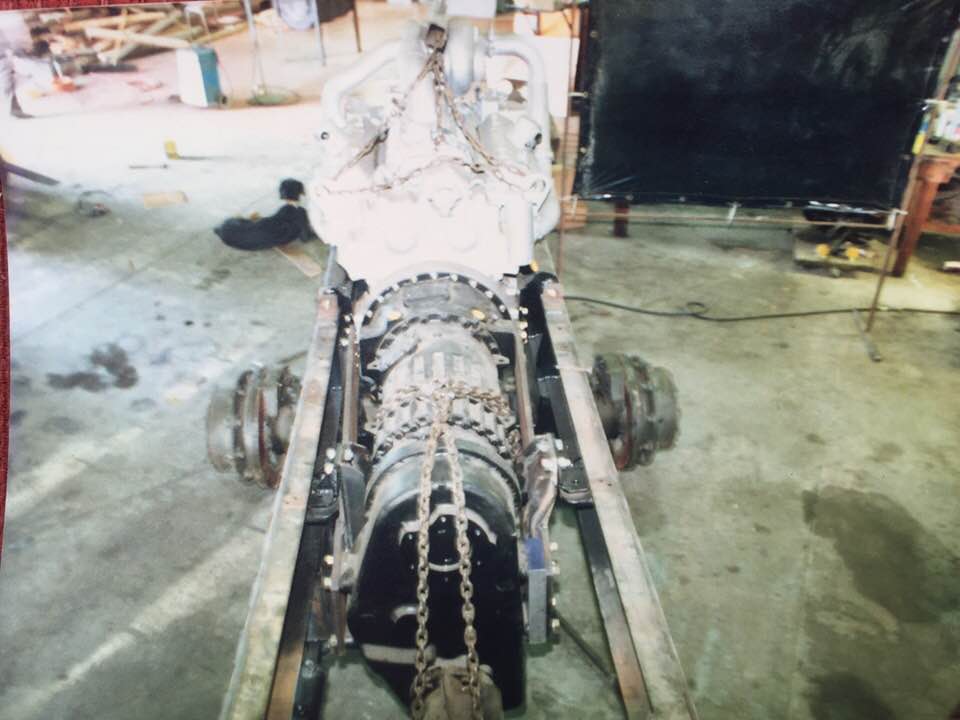
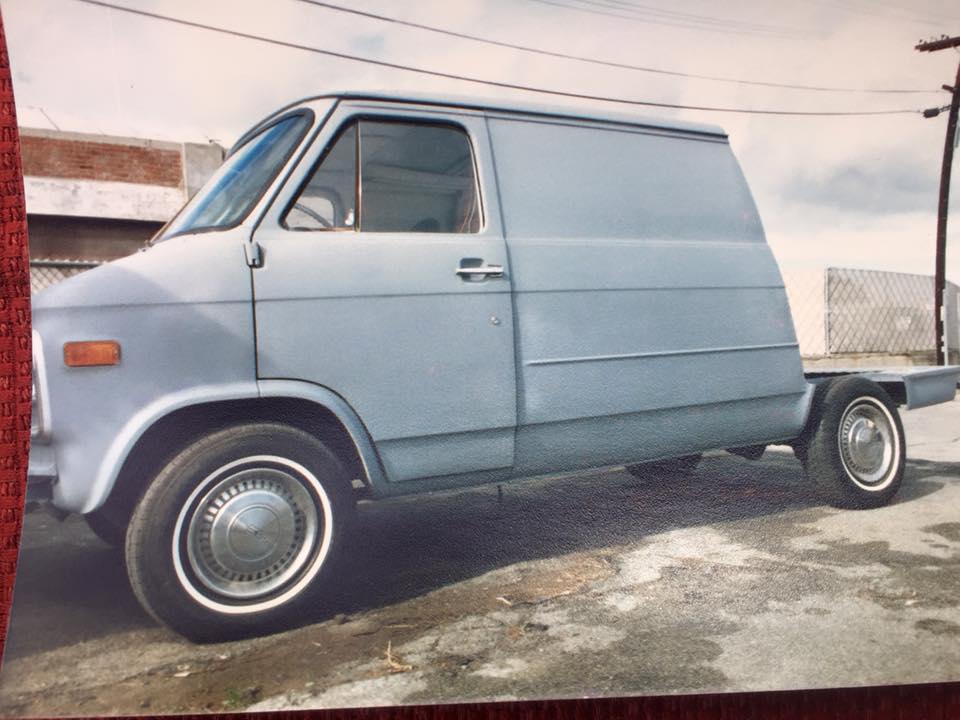
“We didn’t have a proper shop at that point. We’d built the frame and suspension at a shop that had done some heavy-duty trailer work for me; we did the axles, suspension and installed engine and transmission there. Detroit had funded my purchase of a Chevrolet van to go on top of the frame as well, since they were a GM-owned company basically back then. Slave at Streetable Customs helped me with the body modifications; we basically cut the van body off right behind the front doors and mounted the halves separately. This was so the rear of the van body would tilt up like the bed on a truck like Awesome Kong did, to expose the diesel engine and make it a lot easier to work on. And that’s about when Seth Doulton and Jim Ries from Golden State Promotions got involved.”
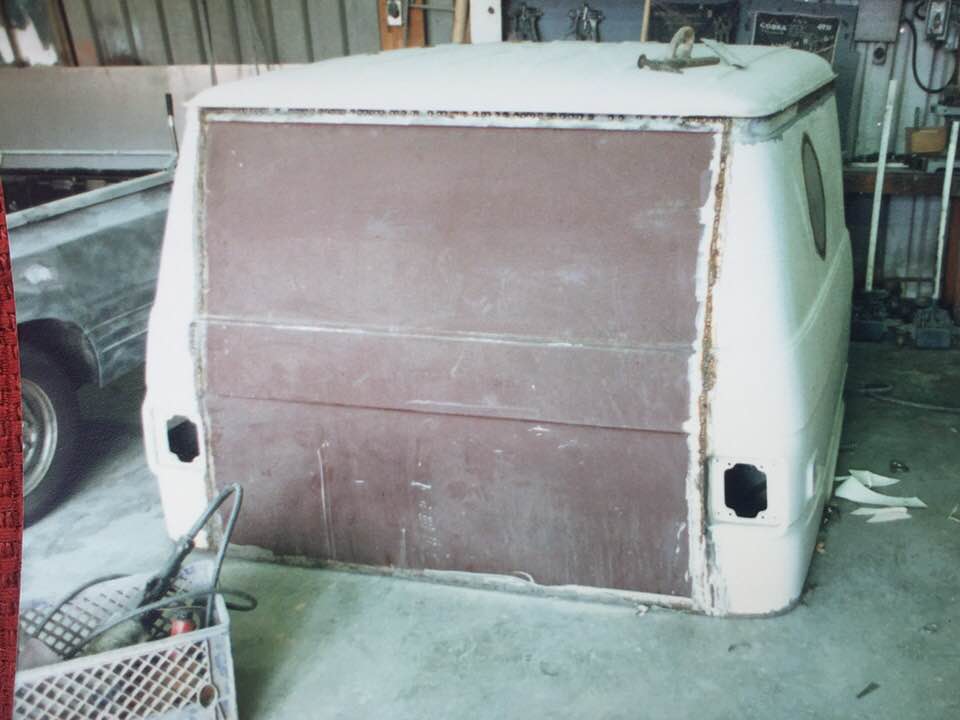
Having recently published my long-form interview with Seth Doulton, I pounced on that topic in hopes of learning more from Oldaker about this relationship, one that I admit I really had no prior knowledge of. “Tell me more about how things worked with you and the Golden State crew, Seth and Jim. I know by 1987 your career seemed to be winding down some with Rollin’ Thunder, so tell me more about that,” I asked of Oldaker.
“Well, Rollin’ Thunder was a dinosaur by that point, compared to what everyone else was building and driving. It was just so heavy and slow, and Rollin’ Thunder 2 was going to outperform it for sure but it was actually going to be even heavier than Rollin’ Thunder 1 we figured, which was already 18,000lbs. By then trucks were starting to get lighter and faster, and I had gotten a sneak peek at where things were about to head with Bob’s (Bigfoot) trucks, and that discouraged me a little bit I guess.”
“I’m assuming you mean that Bob filled you in some on his plans to build BIGFOOT #8?” I asked.
“Yes, so we used to park Rollin’ Thunder at the Bigfoot shop in St. Louis sometimes when we were between shows and needed to layover for a bit. We’d even stay at Bob’s house with them sometimes, and that was where he showed me some of his early computer drawings of this new tube-chassis truck he wanted to build, and that kind of blew my mind because it was going in a totally different direction than what I was aiming to do with Rollin’ Thunder 2,” Oldaker explained. “Once at his house, I also got to drive the BIGFOOT Shuttle around, and being a van guy, that just tickled me pink. That thing was a ball to drive!”
Of course I had to ask about the photos many fans have seen from 1985 of Rollin’ Thunder parked on “The Mound” at BIGFOOT’s St. Louis headquarters. The photos many of us have seen depict Rollin’ Thunder (wearing BIGFOOT #1’s aluminum wheels and short-lived 67”-tall ‘mud tires’) parked alongside an early version of BIGFOOT #5 on the famous 10’-tall Firestone Tundra tires.
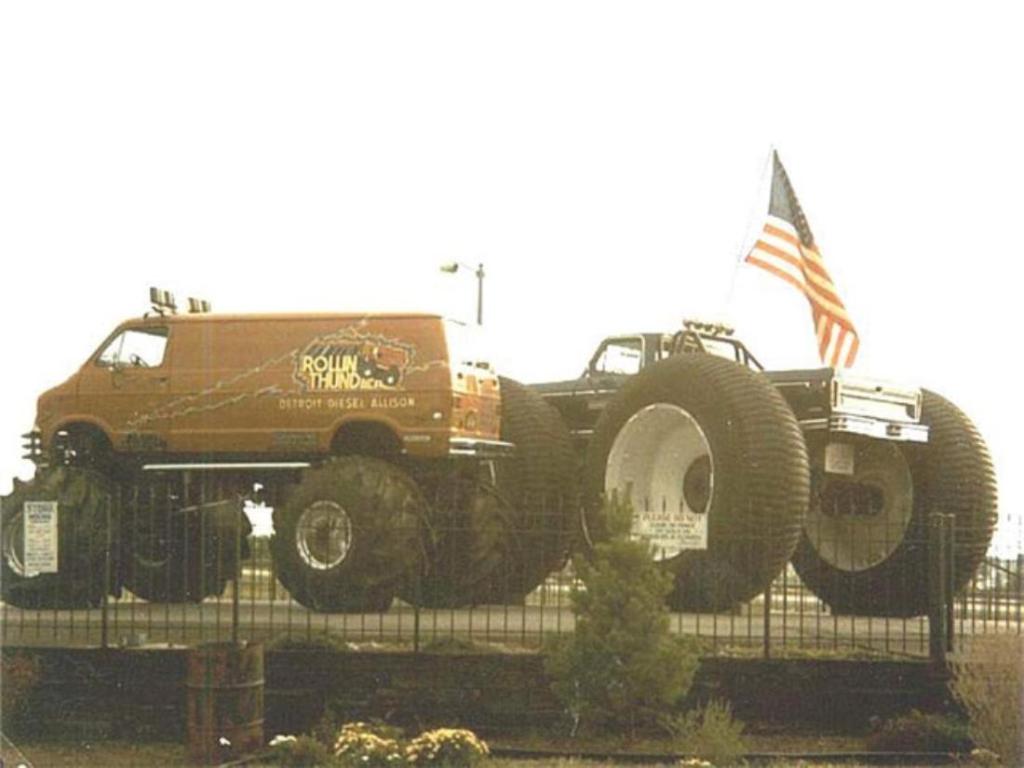
“Yep, that was one of those times we laid over at Bob’s shop, and he asked me one day when we were there if I would be OK with putting the van up on the mound so fans could admire it alongside one of his trucks. He offered to let me use a spare set of tires and wheels he had sitting around so I didn’t have to unload any of that, and I thought that was an honor so of course I said ‘Hell yeah!’ and we put the van up there for a few days or something like that.”
Right! Now back to the whole Rollin’ Thunder 2 and Seth Doulton/Jim Ries thing.
“Well, as I said we really didn’t have a proper shop to really work on Rollin’ Thunder or the new truck at, per se. We’d done some work on the new body at Streetable Customs in Torrance and I’d used Stone Tire in Wilmington a lot to keep the van at between gigs, but no real shop to speak of. Then there was a shop near Anaheim that had done a bunch of work on the hauler and we moved the new truck over there to try to continue working on it. Not long after that, Seth Doulton and Jim Ries approached me about leasing Rollin’ Thunder to perform in their shows and they also asked if I’d be interested in having them help me finish Rollin’ Thunder 2 so they could use it at their shows as well, so we moved it to their shop to try and continue work on it. I’d been training my friend to drive RT1, so once we finished RT2 I would drive the new truck and we could have two vans out running shows. But that obviously never happened. But as I mentioned before, my friend was from England originally, hence why you see some shots of the van running the United Kingdom flag back then.”
“So why did they approach you about leasing RT1 to use in their shows? By 1987 it seems like you were starting to draw back from doing as many shows, due to RT1 being a bit outdated, was that causing you to lose interest in running the truck?” I asked Oldaker.
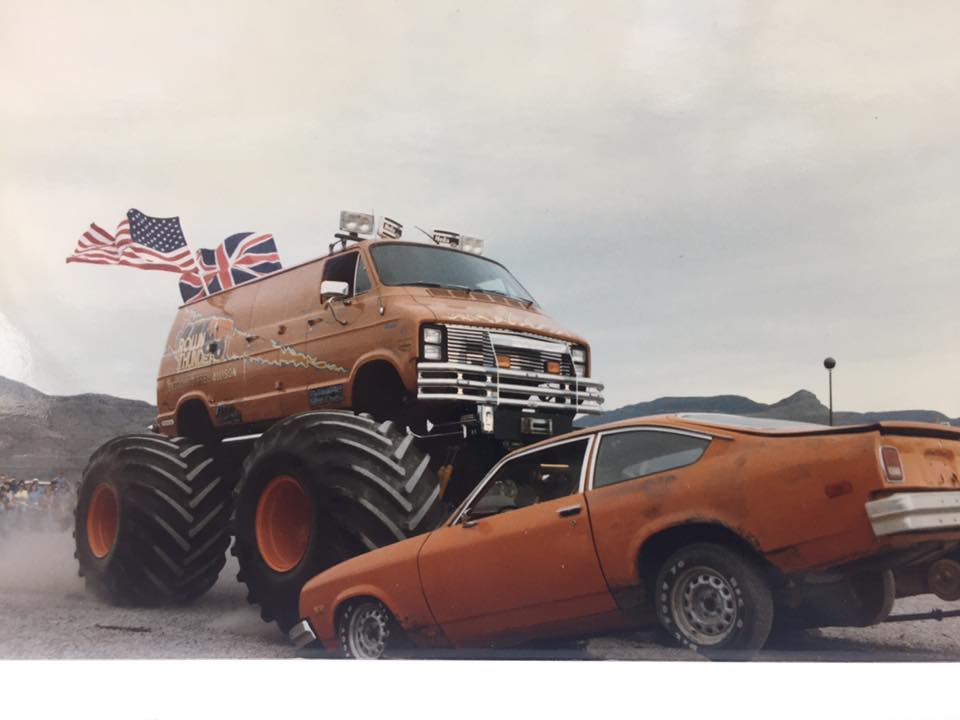
“Well, after I saw Bob’s CAD drawings of his new truck that would become BIGFOOT #8, I realized the direction we were heading with RT2 was not the right way to go about things. And honestly, I just didn’t have it in my to completely change the direction we were going with the project. Seth wanted a really unique truck like Rollin’ Thunder in his shows so he leased it from me and trained a female driver to run it. I ran it at some of his shows but once he trained his driver on the quirks of driving the van, she did a pretty good job from what I remember.”
To help shade this part of Oldaker’s career in better, I reached out to Seth Doulton himself to see what he might recall about Rollin’ Thunder’s brief interlude as a Golden State Promotions truck, and he had this to say:
“Well, first off, I don’t remember the car crush in the street behind the tire store in Wilmington but was probably something Jim set up with the tire store and I probably didn’t know anything about it! But yes, we used Rollin’ Thunder a lot at our shows and Jim drove it some, people really seemed to like the truck. I mean, it was very slow and very noisy but we definitely used it for a while and when we had the girls competing against each other, with Meredith (Doulton) driving The Boss, Sandy Kinney would drive Rollin’ Thunder and Cindy Rosser would drive one of Jeff Bainter’s monster Jeeps.”
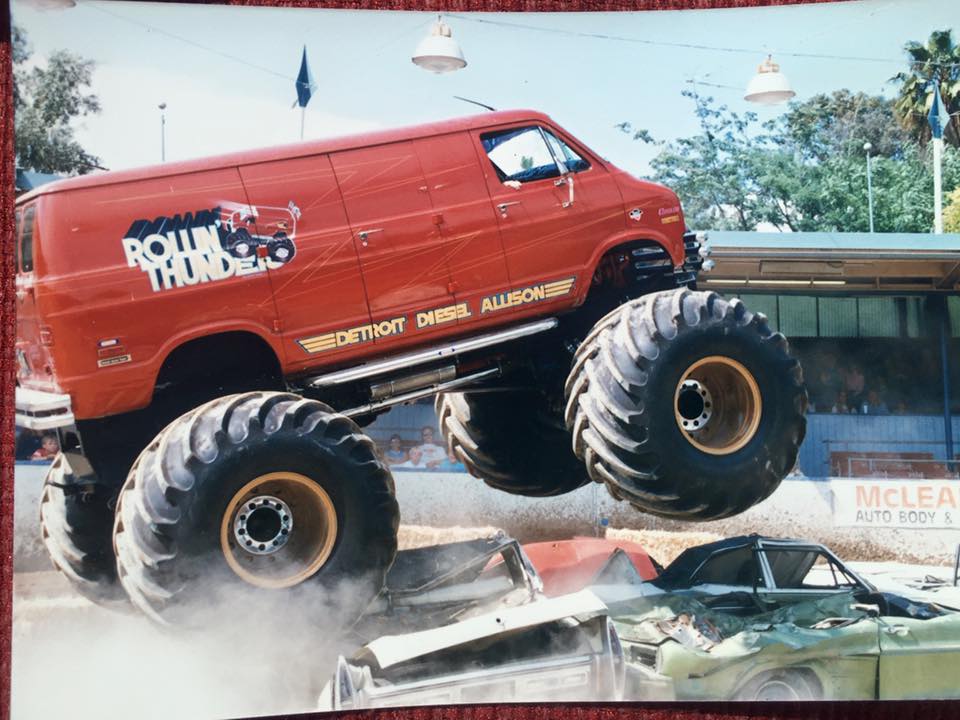
As documented in my prior piece on Seth Doulton, his Golden State Promotions operation was at the time the largest self-contained promotion operating its own fleet of monster trucks, complete with its own fleet of haulers to transport the monsters and show equipment around. Oldaker explained to me that once he’d decided to pause (and eventually give up) on the Rollin’ Thunder 2 build, the project needed someplace to live other than Jim Ries’ shop which at the time was all but overran with Golden State trucks needing maintenance and repairs.
“The guy that Seth had hauling Rollin’ Thunder 1 around told me he had a guy in Barstow, CA with a shop who would let me keep Rollin’ Thunder 2 there for free until we decided what to do with it, and that it could stay there between shows if we ended up finishing it for some reason. Well, I went and did a few months of work driving for Bigfoot on the West Coast of course while Seth was leasing Rollin’ Thunder 1 from me. But by the time I got back from doing some other gigs for another team, the truck driver who set the deal up had disappeared and the building owner in Barstow wanted to charged me thousands of dollars in storage fees for letting the truck just sit and collect dust there. I was pretty pissed off.”
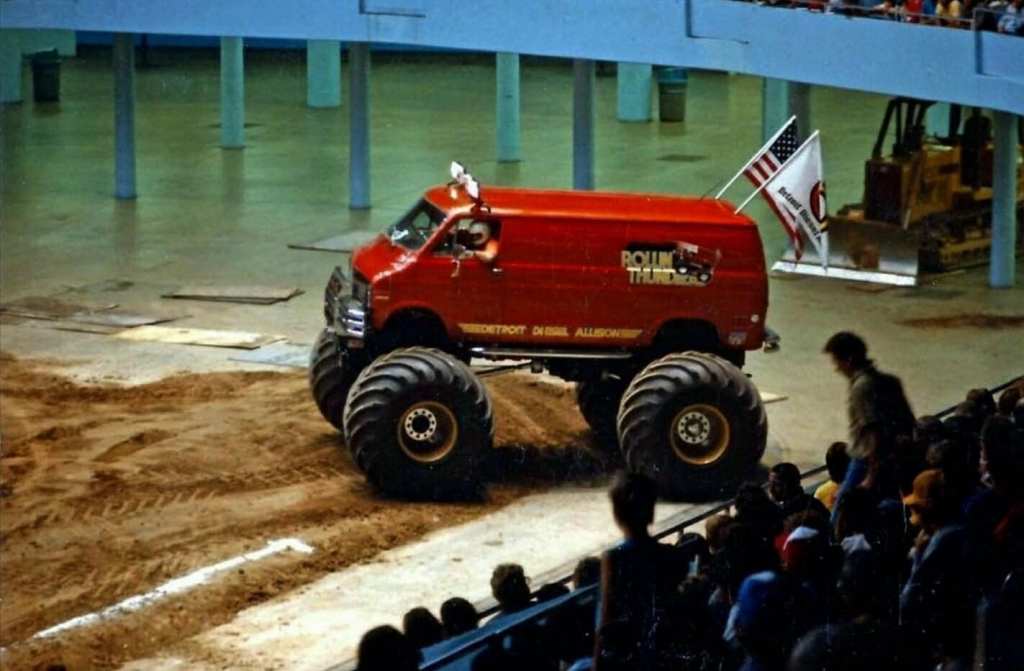

Oldaker’s brief stint as a hired-gun for another well-known monster truck operation can’t be ignored, and we’ll get to that sure enough. But at the time that foray concluded and he returned to find RT2 racking up storage fees and Rollin’ Thunder 1 concluding its time as a leased vehicle for Golden State, it would seem that Oldaker was in a bit of a jam. “How’d you find your way out of that mess in Barstow with the second truck?” I asked him.
“So, somehow, I was able to sell the Detroit 8V91 and the Allison transmission out of the thing, and settled up with the building owner. But as for the rest of the project, I guess it must have sat there in Barstow for god knows how long. I really don’t have any idea what became of the rest of it.”
A short, sad eulogy for a monster that was never to be and sadder still, a foreshadowing of what was to come for Rollin’ Thunder 1 as well, further on down the line. But first, an old friend would come a calling with one hell of an opportunity….
 The Exhaust Fumes Blog by Kyle Doyle